
Why Google Ads Benchmarks Matter More in 2026
Let’s be real for a second. Most business owners open Google Ads, set a daily budget that “feels right,” and hope for the best. Then a month later they’re staring at the bill wondering whether $6 a click is normal or a disaster.
That’s exactly where benchmarks help. They tell you what other advertisers in your industry are paying and getting, so you can judge your own numbers with some context instead of guesswork.
And in 2026, context matters more than ever. Search is changing fast. AI Overviews now sit at the top of many results pages, Google is moving more campaigns into AI Max, and more businesses are fighting for the same clicks. According to Alphabet’s Q2 2026 results, paid clicks grew 13% year over year and cost per click rose 3%. In simple words: more people are buying ads, and each click costs a little more.
At Superio, we manage and audit Google Ads accounts for businesses of all sizes. One pattern we see again and again is this: advertisers who know their industry benchmarks set smarter budgets, spot wasted spend earlier, and make calmer decisions when costs move. Advertisers who don’t know them tend to either overspend or pull the plug too early.
In this guide, we’ll walk you through:
- The average CPC for 23 industries in 2026
- CTR and conversion rate benchmarks
- Cost per lead by industry, and why it matters more than CPC
- How to turn these numbers into a realistic monthly budget
Where This Data Comes From
We’ve built this guide mainly on the WordStream and LocaliQ 2026 search advertising benchmarks, published in May 2026. The report covers 13,474 US search campaigns running between April 2025 and March 2026 across Google Ads and Microsoft Ads. We’ve also added context from Alphabet’s 2026 earnings, Skai’s Q2 2026 paid search report and Google’s own AI Max announcements.
One quick note: the 2026 report uses median values, while earlier reports used averages. Medians are less affected by a few huge accounts, so they give a more realistic picture of what a typical advertiser pays.
Average Google Ads CPC by Industry in 2026
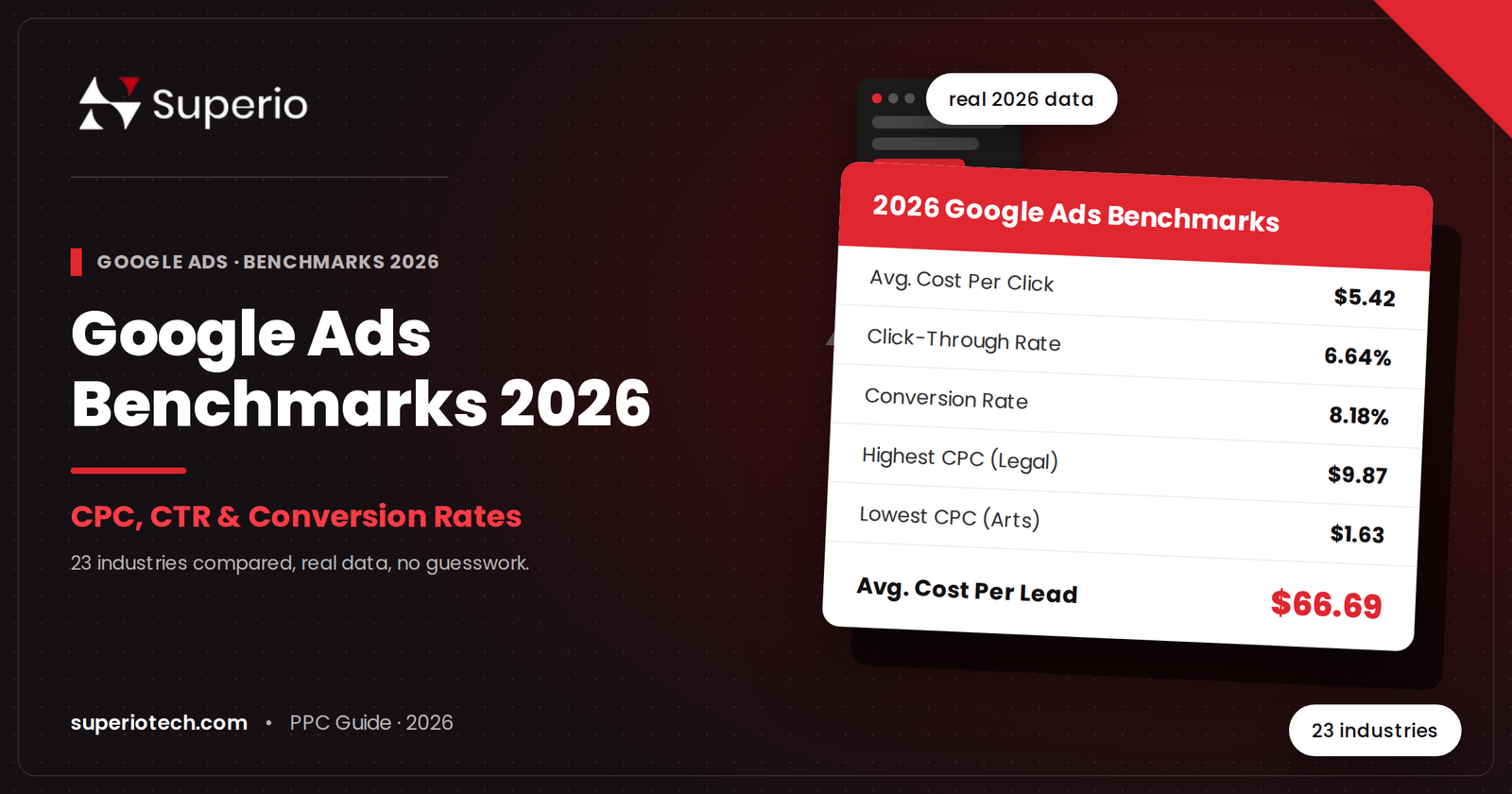
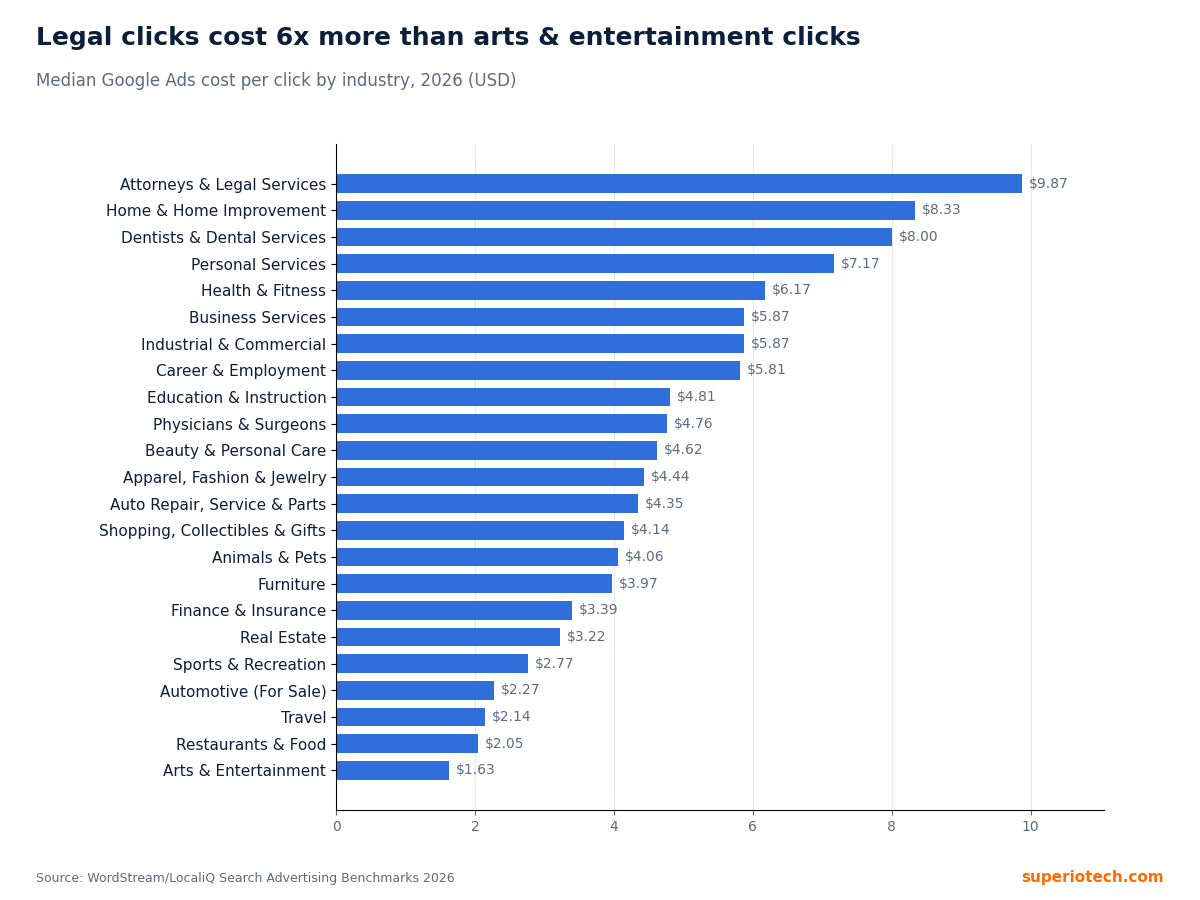
The median CPC across all industries is $5.42, up from $5.26 last year. But that single number hides a huge spread. Here’s what each industry pays per click right now:
What Stands Out in the CPC Data
Legal, home services and dental are the most expensive. Attorneys pay $9.87 per click, home improvement businesses pay $8.33, and dentists pay $8.00. These are all industries where one new customer can be worth thousands of dollars, so advertisers are willing to bid high. In very competitive local markets, some legal keywords go well above $50 per click.
Entertainment, food and travel are the cheapest. Arts and entertainment ($1.63), restaurants ($2.05) and travel ($2.14) have lower CPCs because each sale is usually worth less, and there’s a lot of search volume to go around.
Some industries saw big swings this year. Real estate CPCs jumped 27% (from $2.53 to $3.22), personal services rose 23%, and health and fitness also rose 23%. On the other hand, education dropped almost 23% and beauty fell about 19%.
Why CPC Alone Can Mislead You
Here’s something we tell every Superio client: don’t judge a campaign by CPC alone. A $9 click that turns into a $5,000 client is a great deal. A $1.50 click that never converts is a waste.
That’s why the next two metrics, CTR and conversion rate, are just as important. Together, they tell you whether people are clicking your ads and whether those clicks are turning into leads or sales.
Google Ads CTR and Conversion Rate Benchmarks 2026
The median CTR in 2026 is 6.64%, and the median conversion rate is 8.18%. That means, on average, about 7 out of every 100 people who see a search ad click it, and about 8 out of every 100 people who click end up taking action (a call, a form fill, a booking or a purchase).
Here’s the full breakdown, sorted by conversion rate:
| Industry | CTR (%) | Conversion rate (%) |
|---|---|---|
| Animals & Pets | 7.49 | 16.22 |
| Auto Repair, Service & Parts | 5.56 | 15.51 |
| Education & Instruction | 7.56 | 13.14 |
| Physicians & Surgeons | 6.61 | 12.43 |
| Personal Services | 7.16 | 12.34 |
| Dentists & Dental Services | 5.66 | 10.67 |
| Beauty & Personal Care | 6.75 | 10.35 |
| Industrial & Commercial | 6.57 | 8.20 |
| Restaurants & Food | 6.83 | 8.05 |
| Home & Home Improvement | 6.47 | 8.05 |
| Sports & Recreation | 8.75 | 7.69 |
| Health & Fitness | 5.81 | 6.94 |
| Automotive (For Sale) | 8.28 | 6.01 |
| Arts & Entertainment | 12.75 | 5.91 |
| Travel | 9.32 | 5.83 |
| Attorneys & Legal Services | 5.87 | 5.55 |
| Business Services | 6.10 | 4.85 |
| Apparel, Fashion & Jewelry | 6.64 | 4.50 |
| Shopping, Collectibles & Gifts | 8.28 | 4.01 |
| Real Estate | 7.61 | 3.70 |
| Career & Employment | 5.88 | 3.05 |
| Furniture | 6.57 | 2.99 |
| Finance & Insurance | 9.83 | 2.64 |
Source: WordStream/LocaliQ 2026 benchmarks
How to Read These Numbers
A high CTR doesn’t guarantee sales. Arts and entertainment has the highest CTR (12.75%) but a below-average conversion rate. People click out of curiosity, then leave. Finance and insurance is similar: a strong 9.83% CTR, but only 2.64% of clicks convert, because buying insurance or a loan takes research and trust.
Urgent, local needs convert best. Pet services, auto repair, doctors and dentists all convert above 10%. When your car breaks down or your tooth hurts, you’re not comparing ten websites. You call the first good option.
Education made a big comeback. Its CTR jumped almost 32% this year, while its CPC dropped. For education brands, 2026 is a good time to scale.
If your CTR is well below your industry number, your ads probably aren’t matching what people search for. On the other hand, when CTR looks healthy but conversions stay low, the problem is usually the landing page, the offer or your tracking.
“Costs have gone up, so have click-through rates and conversion rates, indicating generally better performance for advertisers as a whole.” — WordStream, Google Ads Benchmarks 2025
Cost Per Lead by Industry: The Number That Actually Matters
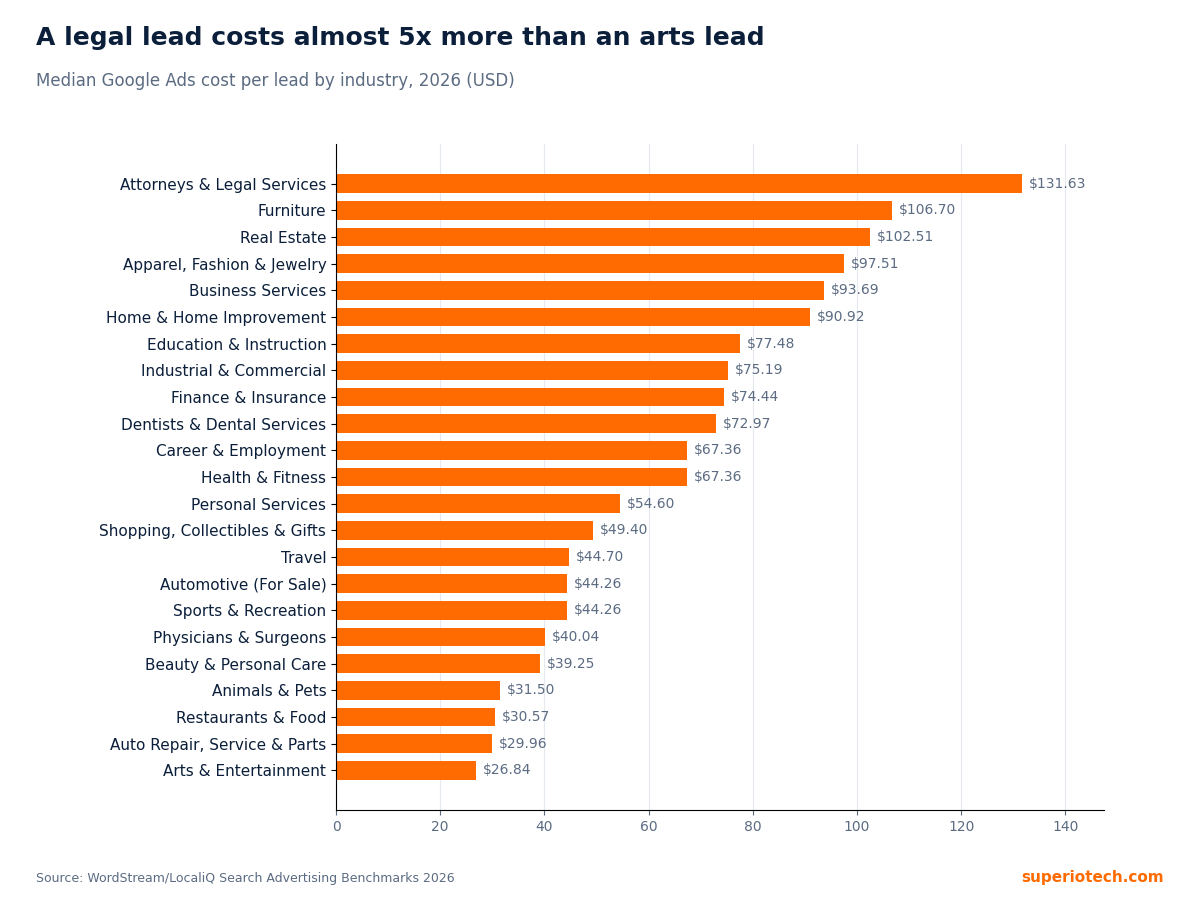
If you only track one benchmark, make it cost per lead (CPL). It combines your CPC and your conversion rate into one simple answer: how much you pay to get a potential customer. The 2026 median is $66.69.
What Drives These Differences?
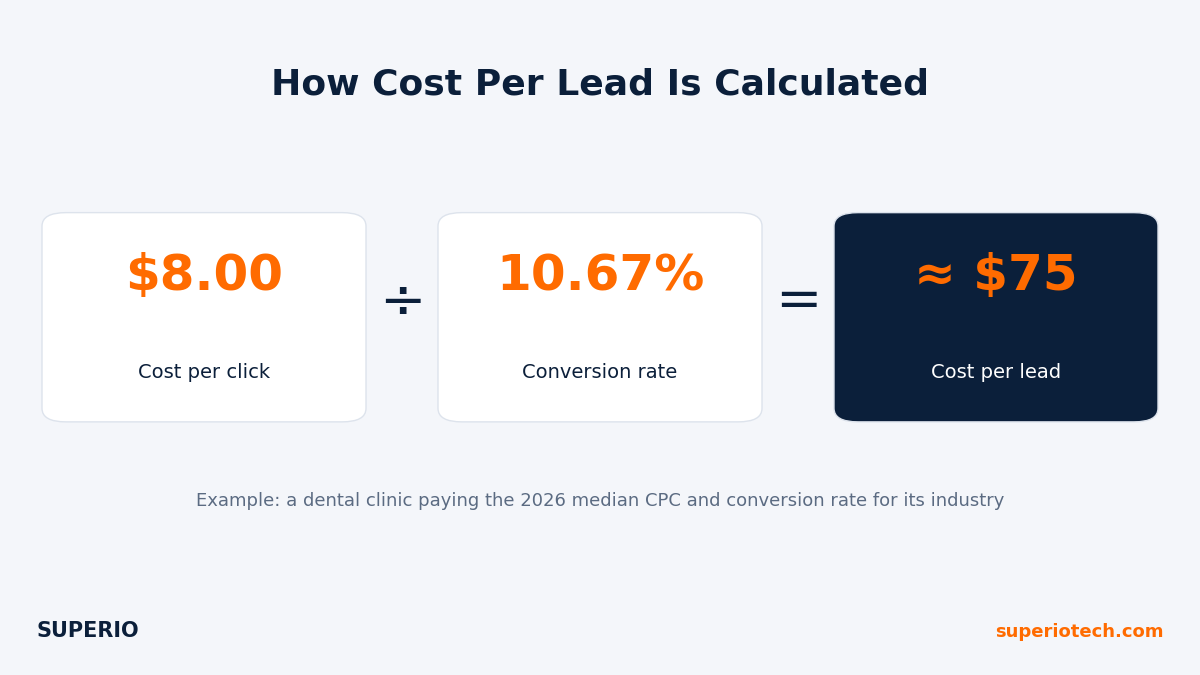
Look closely and you’ll notice something interesting. Real estate has a fairly low CPC ($3.22), but one of the highest costs per lead ($102.51). Why? Because only 3.7% of clicks convert. On the flip side, dentists pay $8 per click but still get leads for about $73, because more than 1 in 10 clicks becomes a booking.
Here are the main factors that push CPL up or down:
- Customer value: Industries where one client is worth a lot (legal, home improvement) can afford, and tolerate, higher lead costs.
- Buying cycle: Big decisions like furniture, property or financial products take longer, so fewer clicks turn into leads right away.
- Competition: More advertisers bidding on the same keywords raises CPC, which raises CPL.
- Landing page quality: A fast, clear page with one strong call to action can cut CPL even when CPC stays the same.
- Tracking accuracy: If calls or form fills aren’t tracked properly, your CPL looks worse than it really is.
Big Year-Over-Year Moves in CPL
Some industries got a lot cheaper this year. Travel CPL fell by about 39% (from $73.70 to $44.70), and beauty and personal care fell almost 35% (from $60.34 to $39.25). Meanwhile, cars for sale went the other way, with CPL rising about 14%.
The lesson? Benchmarks move every year. Checking them once and forgetting about them isn’t enough.
How to Use Benchmarks to Set Your Google Ads Budget
Benchmarks are great, but they don’t pay your bills. What you really want to know is: how much should I spend each month to get the number of leads I need? Here’s the simple method we use at Superio.
Step 1: Decide How Many Leads You Need
Start with your sales goal. If you want 10 new clients a month and you usually close 1 in 4 leads, you need 40 leads.
Step 2: Use Your Industry’s CPC and Conversion Rate
If you don’t have your own data yet, use the benchmarks above. Once your campaigns have run for a few weeks, switch to your real numbers.
Step 3: Do the Math
The formula is simple:
Monthly budget = Leads needed ÷ Conversion rate × CPC
Here’s how that works for three different businesses that each want 40 leads a month:
| Business | CPC (USD) | Conversion rate (%) | Clicks needed | Monthly budget (USD) |
|---|---|---|---|---|
| Law firm | 9.87 | 5.55 | 721 | 7,116 |
| Dental clinic | 8.00 | 10.67 | 375 | 3,000 |
| Real estate agent | 3.22 | 3.70 | 1,081 | 3,481 |
Notice how the dental clinic needs the smallest budget even though its clicks cost more than the real estate agent’s. Conversion rate makes all the difference.
Step 4: Add a Buffer
In our experience, new campaigns need a learning period of two to four weeks. We usually recommend adding a 15 to 20% buffer in the first month for testing keywords, ads and landing pages.
Skip the Math With the Superio PPC Budget Calculator
Don’t want to do this by hand? We built a free tool that does it for you. Enter your CPC, conversion rate and lead goal, and the Superio PPC Budget Calculator shows your ideal monthly budget in seconds.
Ready to plan your 2026 ad budget? Stop guessing and start with real numbers. Try the free Superio PPC Budget Calculator →
CTA shortcode (paste into WordPress):
Free PPC Tool Enter your CPC, conversion rate and lead goal, and get your ideal monthly Google Ads budget in seconds.
How much should you spend on Google Ads?
Final Thoughts: Benchmarks Are Your Map, Not Your Destination
Google Ads isn’t getting cheaper. With CPCs up again in 2026, AI Max changing how campaigns work, and more businesses entering the auction every month, guessing your budget is getting riskier.
The good news? You don’t need to guess. Use these benchmarks to understand where you stand, focus on cost per lead instead of CPC, and build your budget from real numbers.
“A cheap click is only cheap if it turns into a customer. Budget for leads, not clicks.” — Superio PPC Team
If you want an expert to look at your account, the Superio team can review your campaigns, compare them with your industry benchmarks and show you exactly where your budget is leaking.
Calculate your budget with the Superio PPC Budget Calculator →
Closing CTA shortcode (paste into WordPress):
Free PPC Audit Our PPC team will compare your account with 2026 industry benchmarks and show you exactly where to cut waste and grow leads.
Find out where your Google Ads budget is leaking