
Most off-page SEO techniques that worked ten years ago now do nothing, and a few will actively harm you. However, the handful that still work are more effective than ever, mainly because so many people gave up on doing them properly.
So this guide covers twelve techniques that genuinely move rankings in 2026, the ones you should stop using, and how to measure whether any of it is working. Everything here assumes you are building real relationships rather than buying links.
Table of Contents
- What Is Off-Page SEO?
- 12 Off-Page SEO Techniques That Still Work
- Where Quality Backlinks Come From
- What Makes a Backlink Good?
- Techniques That Stopped Working
- How Many Backlinks Do You Need?
- Off-Page SEO for Local Businesses
- How to Measure Off-Page SEO
- Outreach That Gets Replies
- Do Social Signals Affect Rankings?
- Mistakes to Avoid
- Conclusion
What Is Off-Page SEO?
If you are new to the subject, our guide to what SEO is covers the fundamentals first. Off-page SEO is everything that happens away from your website which affects how search engines judge it: backlinks, brand mentions, citations, reviews and the general signal that other people find you credible.
Put simply, on-page work decides whether a page deserves to rank, technical work decides whether it can be found, and off-page work decides whether anyone believes you. All three are necessary, although they rarely need equal attention at the same time. Our comparison of on-page vs off-page SEO explains how to split your effort.
Importantly, off-page work is slow. Most campaigns take three to six months to show up in rankings, which is why it should start only after your on-page basics and technical health are in order. Otherwise you are sending authority to pages that cannot use it.
12 Off-Page SEO Techniques That Still Work
1. Digital PR and data studies
Publish something journalists want to cite: original survey data, a price index, an annual report on your industry. Because the asset does the work, one good study can earn links for years. This is the highest-value off-page tactic available and also the hardest.
2. Guest posting on sites that have real readers
Guest posting still works when the host site has genuine traffic, an editorial standard and a topic close to yours. Conversely, networks of thin blogs built purely for links are worthless. Our guide on SEO in guest posting covers how to judge a site before you pitch.
3. Reclaiming unlinked brand mentions
Search for your brand name and find articles that mention you without linking. Then email the author and ask politely. Since the journalist already chose to write about you, this is the highest conversion rate in all of link building.
4. Broken link building
Find dead pages on relevant sites, create something better on the same topic, then tell the webmaster their link is broken and offer yours. It takes patience, yet it works because you are solving their problem rather than asking for a favour.
5. Expert quotes for journalists
Respond to journalist requests on platforms built for sourcing experts. Quick, specific, quotable answers earn links from genuinely authoritative publications. Moreover, the same quotes build the personal brand of whoever gives them.
6. Niche directories and industry listings
Forget the generic directory lists from 2012. Instead, target the association, chamber of commerce, supplier and marketplace listings that people in your industry actually use. These links are modest in value but highly relevant and very stable.
7. Google Business Profile and local citations
For any business with a location or service area, consistent name, address and phone details across local directories remain a genuine ranking factor. Our guide to local SEO for small businesses covers the full setup.
8. Customer reviews
Reviews influence both local rankings and click-through rate from search results. Ask every satisfied customer, respond to each review publicly, and never buy them, since platforms detect and remove fake reviews routinely.
9. Podcast and interview appearances
Appearing as a guest earns a link from the show notes, exposure to a new audience and quotable material you can reuse. Additionally, podcast hosts are far easier to reach than editors at large publications.
10. Partnerships and resource pages
Suppliers, clients, associations and complementary businesses all maintain partner or resource pages. Therefore, start your link building with people who already know you; these are the easiest links you will ever earn.
11. Genuine community participation
Answering questions in industry forums, professional communities and question sites builds referral traffic and brand recognition. Most of these links are nofollow, which is fine, because the value here is visibility rather than authority transfer.
12. Building branded search demand
When people search your brand name directly, every other signal improves. Content, social presence, events and word of mouth all feed this. Notably, branded search growth is one of the strongest indicators that your wider marketing is working.
Where Quality Backlinks Come From
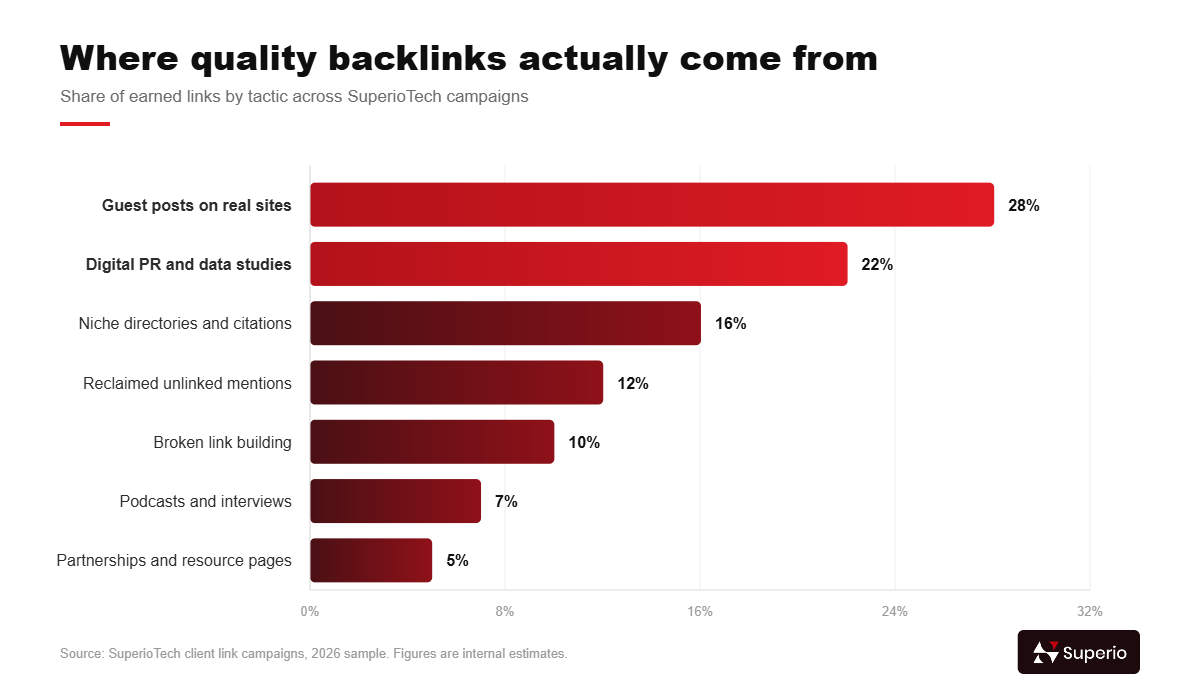
Notice that no single tactic dominates. In practice, a healthy backlink profile looks varied, because a site that earns links from twenty different types of source looks natural, whereas one that earns 400 guest post links looks manufactured.
“Any links intended to manipulate rankings may be considered link spam.” — Google Search Central
What Makes a Backlink Good?
Before you chase anything, you need a way to judge an opportunity in thirty seconds. These five questions cover it.
Does the site have real traffic? A site nobody visits passes very little, whatever its third-party score says. Check whether it ranks for anything in your topic.
Is it topically relevant? A link from a mid-sized site in your industry beats one from a large general blog that covers everything from crypto to cooking.
Would the link exist without SEO? If the page only exists to host outbound links, that is a clear signal of a link farm. Equally, a “write for us” page with 400 unrelated posts is a warning.
Is it editorially placed? Links inside the body of an article, surrounded by relevant text, carry more weight than footer or sidebar links.
Is the anchor text natural? Brand names, URLs and descriptive phrases all look normal. Repeated exact-match commercial anchors do not.
Consequently, one link passing all five tests is worth more than a hundred that pass none, which is why quality screening saves far more time than it costs.
Techniques That Stopped Working
| Technique | Status | Why |
|---|---|---|
| Buying links in bulk | Harmful | Violates spam policies and risks manual action |
| Private blog networks | Harmful | Detected by footprint; links are devalued |
| Blog comment links | Useless | Nofollow by default and widely spammed |
| Mass directory submissions | Useless | No editorial standard, no traffic |
| Article spinning | Harmful | Thin duplicate content on both sides |
| Exact-match anchor at scale | Harmful | An obvious manipulation pattern |
| Social bookmarking sites | Useless | Nofollow, no readers, no signal |
Generally, if a service promises hundreds of links for a small fee, it is selling you something from the list above. Cleaning up afterwards costs far more than the links ever did.
Need Links From Real Sites?
Get Off-Page SEO Handled by SuperioTech
We earn links through digital PR, genuine guest placements and outreach, and we report every link with the site and its traffic.
How Many Backlinks Do You Need?
There is no fixed number, because the honest answer depends entirely on your competition. So instead of guessing, do this: search your target keyword, open the top five results, and look at how many referring domains each one has.
That figure is your benchmark. If the leaders have 40 referring domains and you have 6, you know the scale of the gap. Conversely, if they have 400, you should probably target an easier keyword first.
| Competition level | Typical referring domains | Realistic timeline |
|---|---|---|
| Local service keyword | 10 – 40 | 3 – 6 months |
| National niche keyword | 50 – 150 | 6 – 12 months |
| Competitive commercial keyword | 200+ | 12 months or more |
Crucially, referring domains matter more than total links. Fifty links from fifty different websites outperform five hundred links from one.
Off-Page SEO for Local and Small Businesses
If you serve a city rather than a country, the priorities change. Links still matter, yet citations, reviews and proximity signals often matter more.
Start with your Google Business Profile, because it is the single highest-impact off-page asset a local business has. Complete every field, add real photographs, choose accurate categories and post updates occasionally. Afterwards, make sure your business name, address and phone number match exactly everywhere they appear online, since inconsistencies split your local signals.
Next, target local link sources that national competitors cannot reach: the chamber of commerce, local news coverage, supplier pages, sponsorships of a school or sports team, and listings from any association you belong to. These are genuinely easier to earn and highly relevant.
Finally, treat reviews as an ongoing process rather than a campaign. A steady stream of recent reviews outperforms a burst of fifty followed by silence, and responding to each one publicly shows both customers and search engines that the business is active.
How to Measure Off-Page SEO
Track four things monthly and ignore everything else:
- Referring domains. The number of unique websites linking to you, which should rise steadily rather than in spikes.
- Link quality. Whether those sites have real traffic and topical relevance, not just a high third-party score.
- Branded search volume. Rising brand searches show your off-page work is building recognition.
- Referral traffic. A link that sends visitors is worth more than one that only passes authority.
Meanwhile, do not judge a campaign by domain authority scores alone. They are third-party estimates, not anything Google uses, and they are easy to inflate artificially.
Outreach That Gets Replies
Every technique above eventually depends on sending an email a stranger wants to answer. Fortunately, the pattern is consistent.
Keep it under 120 words. Name the specific article you are referencing, say what you are offering in one sentence, and make the ask explicit. Templates fail because they are obviously templates, so personalise the first line with something only a reader of that page would know.
Furthermore, send from a real person at your company domain, not from a generic marketing address. Follow up exactly once, a week later, then move on. In our experience, a well-targeted list of thirty sites outperforms a generic blast to three hundred, both in reply rate and in the quality of what you end up with.
Do Social Signals Affect Rankings?
Shares and likes are not direct ranking factors, and Google has said so repeatedly. Nevertheless, social activity influences rankings indirectly, which is why dismissing it entirely is a mistake.
Here is the actual mechanism. A post that circulates widely gets seen by writers, journalists and site owners, and some of them link to it from their own websites. Those links are the ranking factor; the social post was simply the distribution. Similarly, social profiles themselves often rank for branded searches, which gives you more control over what appears when someone looks you up.
Therefore, treat social as a discovery channel for your linkable assets rather than as an SEO tactic in itself. Publish the study, then make sure the people who might cite it actually see it.
Mistakes to Avoid
- Starting off-page work too early. Fix the site first or you waste the authority.
- Chasing volume over relevance. One link from a respected industry site beats fifty from unrelated blogs.
- Using exact-match anchors repeatedly. Vary anchor text the way natural links do.
- Buying packages of links. The short-term lift is rarely worth the cleanup.
- Judging progress weekly. Off-page results take months, not days.
- Ignoring brand entirely. Links follow recognition more often than the reverse.
If you are planning a budget for this work, our breakdown of SEO cost in Pakistan explains what realistic link building actually costs.
Conclusion
In conclusion, the off-page SEO techniques that still work all share one quality: they give someone a real reason to mention you. Publish research worth citing, appear where your audience already listens, reclaim the mentions you have already earned, keep your local listings accurate and collect genuine reviews. Then measure referring domains and branded search rather than vanity scores.
Above all, avoid anything that promises links in bulk. If you would rather have this run properly, our SEO services in Pakistan cover digital PR, outreach and reporting alongside on-page and technical work.
Ready to Build Real Authority?
Book a Free Strategy Session
Share your domain and target keywords, and we will show you the link gap against your competitors and how to close it.