
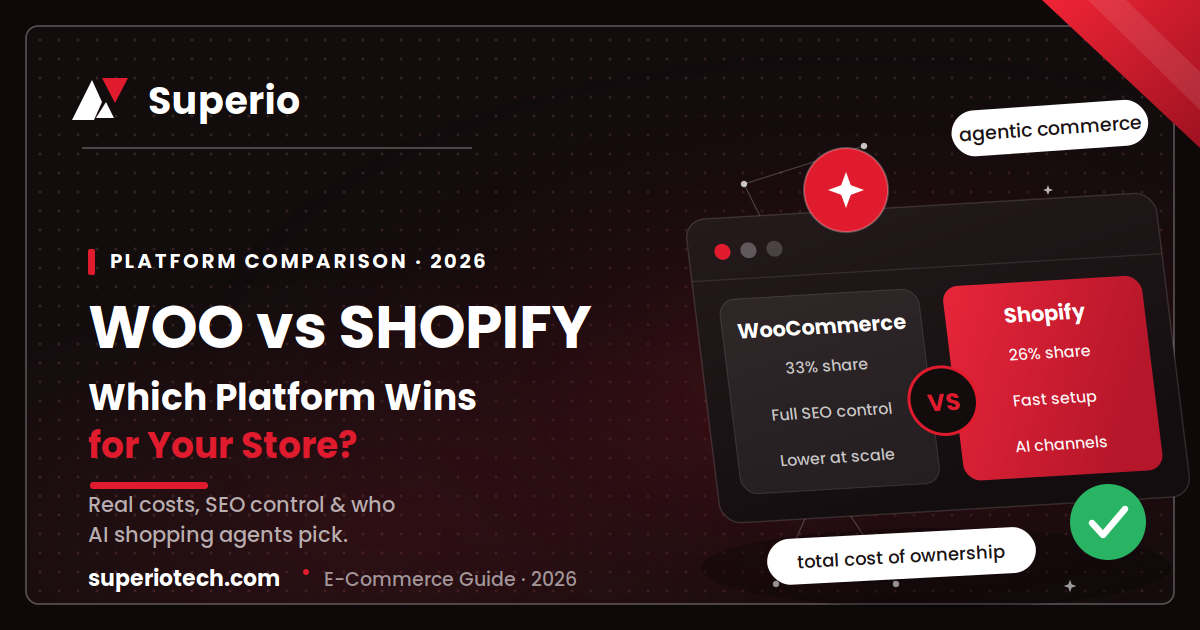
In the WooCommerce vs Shopify debate, WooCommerce is the better choice for content-driven stores that need full SEO control and lower running costs at scale. In contrast, Shopify is better for merchants who want to launch fast without managing infrastructure. WooCommerce holds roughly 33% of global stores versus Shopify’s 26%, but Shopify leads among high-traffic sites. However, in 2026 the deciding factor for many merchants is no longer features — it is which platform gets their products in front of AI shopping agents.
Table of Contents
- What is the actual difference between WooCommerce and Shopify?
- WooCommerce vs Shopify: which one actually costs more?
- WooCommerce vs Shopify: which is better for SEO?
- Which platform is better for AI shopping agents?
- What about Pakistani and regional merchants?
- Speed, security and maintenance
- WooCommerce vs Shopify: which should you choose?
- How Superio Tech can help
What is the actual difference between WooCommerce and Shopify?
WooCommerce is a free, open-source plugin that turns a WordPress site into a store. You choose and pay for your own hosting, and you are responsible for updates, security and backups. In return you own everything and can modify anything. The plugin itself is available from WooCommerce.com.
On the other hand, Shopify is a hosted platform. You pay a monthly subscription and Shopify handles servers, security patches, SSL and PCI compliance. In other words, you trade control for convenience and a predictable bill.
In fact, everything below follows from that one structural difference.
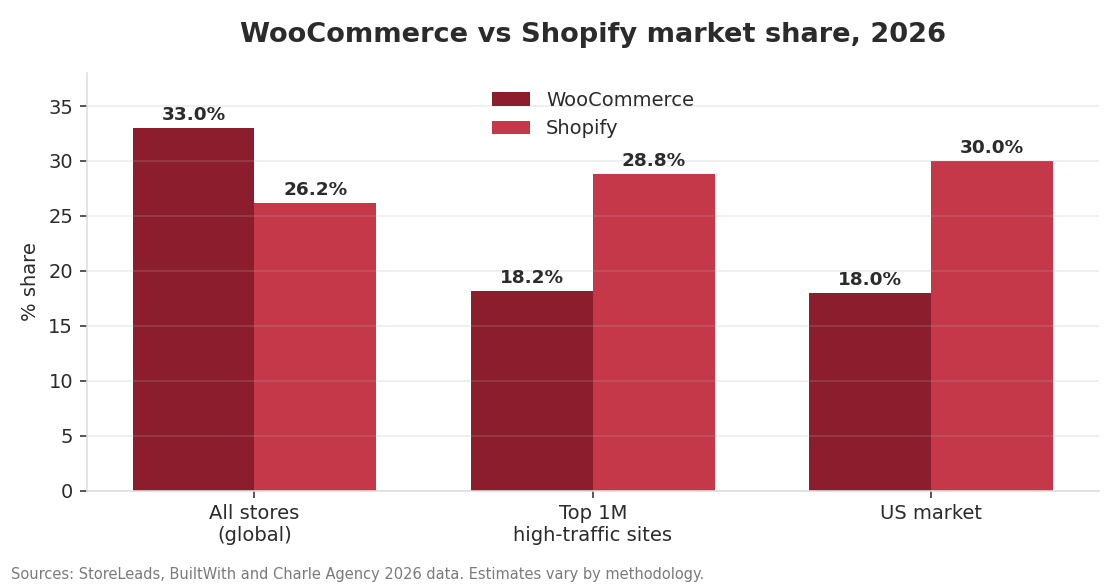
The pattern in the data is consistent: WooCommerce wins on volume of stores, Shopify wins where the money is. However, among the top one million highest-traffic e-commerce sites, Shopify’s share is meaningfully ahead. That does not make it better — it reflects that larger merchants often prefer to outsource infrastructure.
WooCommerce vs Shopify: which one actually costs more?
| Cost line | WooCommerce | Shopify |
| Platform / plugin | Free | $39 – $399 per month |
| Hosting | $60 – $600 per year | Included |
| SSL and PCI compliance | Usually free / included in hosting | Included |
| Premium extensions | $400 – $1,200 per year | Apps, $0 – $300 per month |
| Maintenance | $500 – $2,400 per year | Included |
| Transaction fee on third-party gateways | None | 0.5% – 2% |
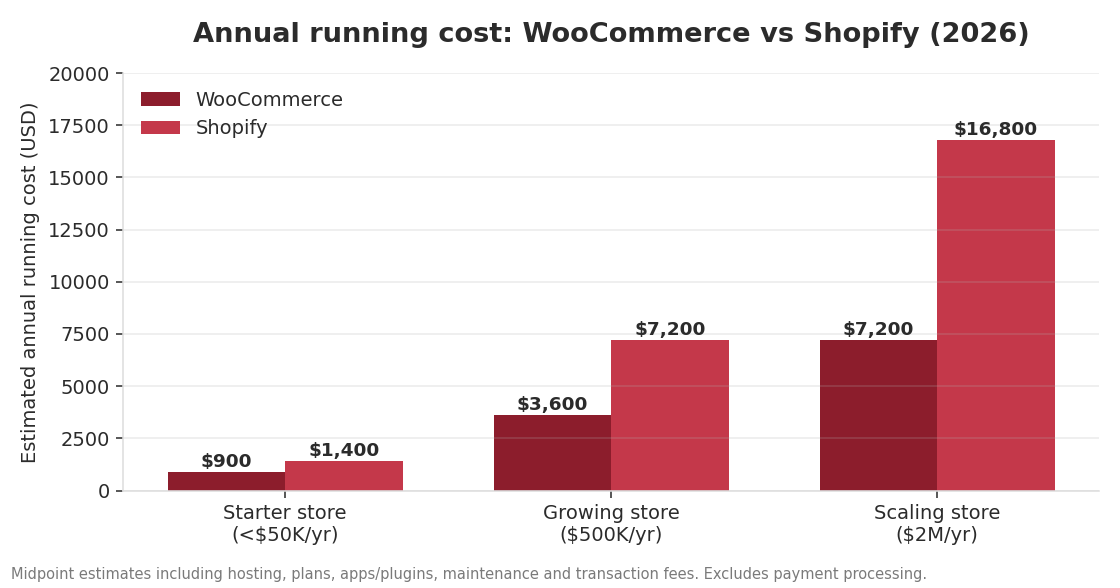
The short version: WooCommerce is cheaper if you have technical support available. Shopify is cheaper if your alternative is paying someone to manage servers.
Two costs merchants consistently miss:
- Shopify’s third-party gateway fee. Using a payment provider other than Shopify Payments adds a percentage on every order. At high volume this is the largest hidden line in the comparison — and in Pakistan, where Shopify Payments is not available, it applies by default.
- WooCommerce maintenance. Of course, free software is not free to run. Unmaintained WooCommerce stores break, and broken checkouts cost more than any subscription.
“Shopify sells you time. WooCommerce sells you control. Most merchants already know which one they’re short of — they just haven’t priced it.”
— Superio Tech e-commerce team
WooCommerce vs Shopify: which is better for SEO?
WooCommerce, for most content-led businesses — and the gap is structural rather than a matter of preference.
| SEO factor | WooCommerce | Shopify |
| URL structure control | Full | Restricted — /products/ and /collections/ are fixed |
| Schema markup control | Full, editable | Limited to theme and app support |
| Blogging and content depth | Excellent (WordPress) | Basic |
| Redirect management | Full | Supported, less flexible |
| Technical SEO plugins | Extensive ecosystem | Smaller app selection |
| Speed out of the box | Depends on hosting | Consistently fast |
Meanwhile, Shopify handles the fundamentals well — automatic sitemaps, clean meta management, fast hosting. But the fixed URL paths frustrate large-catalogue SEO, and content publishing on Shopify is noticeably weaker than WordPress.
The rule: if organic search is your main acquisition channel and you publish regularly, WooCommerce has the higher ceiling. If paid social is your main channel, that advantage matters far less. In addition, Google’s Search documentation covers the product structured data both platforms need to get right.
Planning to Sell Online?
Launch Your Online Store With SuperioTech
From store setup to payments, delivery and marketing, we handle the full e-commerce journey for you.
Which platform is better for AI shopping agents?
This is the question that barely existed two years ago and now decides real revenue. AI assistants increasingly research, compare and complete purchases inside a single conversation rather than sending shoppers to your site.
So far, Shopify has moved first here. For example, it has built infrastructure to push merchant catalogues into AI shopping surfaces, and merchant-side data on AI-driven traffic growth has been substantial. Shopify’s own AI trends research reports that a large majority of customers now expect AI shopping agents to help them buy online. Search Engine Land’s 2026 e-commerce trends guide reaches a similar conclusion about where discovery is moving.
What this means practically:
- On Shopify, the path is largely a configuration job — keep your catalogue accurate and opt into the AI channels.
- On WooCommerce, there is no single switch, but nothing blocks you either. Specifically, you need clean product schema, an accurate product feed, correct stock and pricing data, and fast pages. Done properly, WooCommerce products are just as readable to an agent.
Similarly, the failure mode is identical on both platforms: messy product data. After all, agents choose from catalogues they can parse. Missing attributes, inconsistent titles and stale stock counts remove you from consideration before any comparison happens. We cover the mechanics in our guide to what is agentic commerce.
“Your product feed is now a sales channel. Treat it like a storefront, not like a spreadsheet nobody looks at.”
— Superio Tech e-commerce team
What about Pakistani and regional merchants?
Local reality changes the maths considerably:
- Payment gateways. First, jazzCash, Easypaisa and HBL Pay integrate readily with WooCommerce. In contrast, on Shopify you are typically working through third-party providers, which triggers Shopify’s additional transaction fee on every order.
- Cash on delivery. Also, COD remains a large share of Pakistani e-commerce. WooCommerce handles COD workflows, partial payments and courier integrations with more flexibility.
- Courier integrations. Local couriers such as TCS, Leopards and M&P have mature WooCommerce plugins.
- Currency and pricing. In addition, WooCommerce hosting is payable in PKR through local hosts. By comparison, Shopify’s subscription is a recurring USD cost, which fluctuates with the exchange rate.
- Skills availability. WordPress developers are far easier and cheaper to hire locally than Shopify specialists.
For most Pakistan-focused stores, these five points push the decision toward WooCommerce. For brands selling primarily to the US, UK or Gulf, Shopify’s advantages reassert themselves. Our website cost in Pakistan guide has the local build figures for both.
Speed, security and maintenance
Speed. Shopify is fast by default because the infrastructure is managed for you. WooCommerce can be equally fast or faster, but only on good hosting with proper caching, image optimisation and a CDN. On cheap shared hosting it will be slower. web.dev sets the benchmarks you should be measuring against.
Security. Meanwhile, Shopify handles PCI compliance and patching. On the other hand, WooCommerce security is your responsibility: core and plugin updates, a firewall, malware scanning and daily backups. Still, this is entirely manageable — it just has to be somebody’s job.
Maintenance. This is the honest dividing line in the WooCommerce vs Shopify choice. Shopify’s subscription is partly a maintenance fee you never think about. With WooCommerce that work still exists; you either do it, hire it, or eventually pay for the consequences.
WooCommerce vs Shopify: which should you choose?
A decision rule that holds up in practice:
Choose Shopify if:
- You want to launch in days, not weeks
- You have no technical team and no maintenance budget
- Your traffic comes mainly from paid social and ads
- You sell primarily in the US, UK, EU or Gulf
- Predictable monthly billing matters more than total cost
Choose WooCommerce if:
- Organic search and content are core to your growth
- You already run a WordPress site
- You need local payment gateways, COD or courier integrations
- You want full control over URLs, schema and checkout
- You are doing meaningful volume and want lower long-run costs
Still undecided? Default to Shopify if you are pre-revenue and testing a product. Default to WooCommerce if you are established, content-driven and planning to scale. Switching later is possible in both directions — see our guide to migrate from WooCommerce to Shopify — but migrations cost time and risk SEO, so choosing correctly now is worth the deliberation.
How Superio Tech can help
We build and maintain stores on both platforms, which means we have no stake in which one you pick. A typical engagement starts with a short scoping call to establish your volume, channels, payment requirements and internal capacity — then we recommend the platform that fits, not the one we prefer to build on. Our e-commerce development services cover WooCommerce builds and migrations, and our Shopify store development team handles setup, theme work and AI-channel configuration.
Not sure which platform fits?
Get a free platform recommendation
Tell us your product range, target market and monthly volume. We'll tell you which platform makes sense — and what it will cost to build.