
WordPress website development in 2026 means building on the block editor, targeting Core Web Vitals from day one, and structuring content so AI search engines can quote it. In general, a standard five-page business site takes two to four weeks and costs PKR 35,000–80,000 in Pakistan or $1,500–$4,000 internationally. By comparison, custom builds with commerce or integrations run PKR 125,000–500,000 and take five to nine weeks.
Table of Contents
- What is WordPress website development in 2026?
- Why do businesses still choose WordPress over Webflow, Wix or Shopify?
- What does a WordPress website cost in 2026?
- How long does WordPress website development take?
- Headless WordPress or classic WordPress — which do you need?
- How do you build a WordPress site that shows up in AI Overviews and ChatGPT?
- What should you ask before hiring a WordPress development company?
- Common WordPress website development mistakes
- How Superio Tech builds WordPress sites
What is WordPress website development in 2026?
WordPress website development is the process of building a website on the WordPress content management system — planning the structure, designing the pages, building templates, adding functionality through plugins or custom code, and configuring hosting, security and SEO before launch.
However, what changed in 2026 is the *how*. Three shifts matter:
- Block-first building. New sites are built with native blocks and Full Site Editing rather than third-party page builders. Cleaner code, fewer dependencies, easier handover.
- Performance as a requirement, not a phase. Speed work happens during the build, not as a rescue job afterwards.
- AI-readable structure. Schema markup, clear heading hierarchy and answer-first content are now part of a standard build, because a growing share of searches ends inside an AI summary instead of on your site.
“The platform did not get replaced. The expectations around it got much higher. A WordPress site that would have passed in 2022 fails on speed, schema and accessibility today.”
— Superio Tech development team
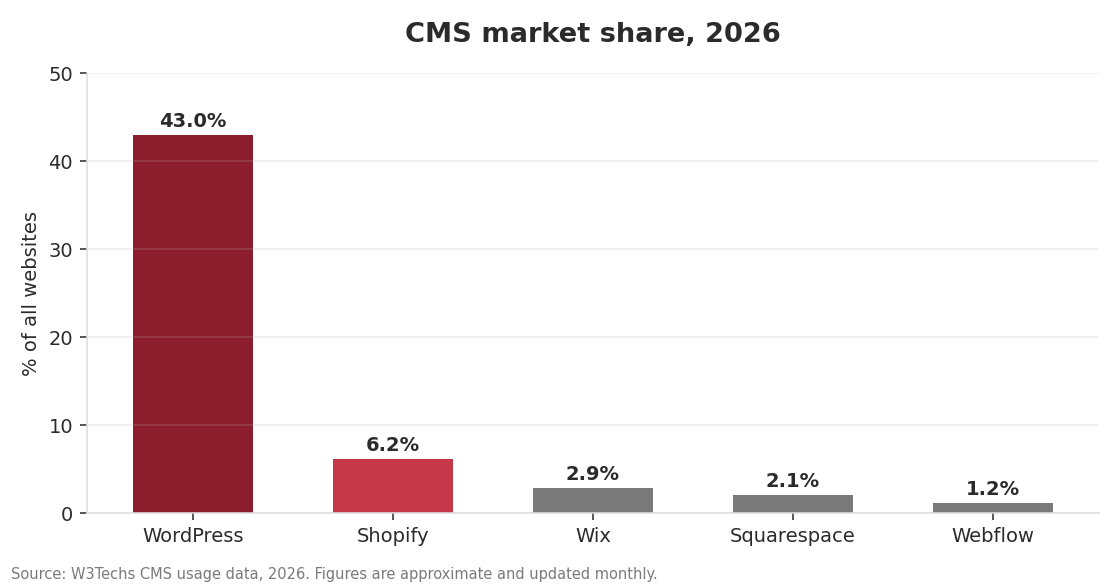
Bar chart showing WordPress holding 43% CMS market share in 2026
WordPress remains the default choice for content-driven businesses because the ecosystem is enormous, hiring is easy, and you own the site outright. W3Techs tracks this share monthly if you want to watch the trend yourself.
Why do businesses still choose WordPress over Webflow, Wix or Shopify?
Four practical reasons come up in almost every client conversation:
- First, the software is open source and free from WordPress.org. In other words, you are not renting your website.
- SEO control. URL structures, schema, redirects and internal linking are fully editable. In contrast, hosted platforms restrict several of these.
- Content depth. If organic search is a primary acquisition channel and you publish regularly, WordPress is very hard to beat.
- Exit cost. Also, moving off a hosted builder is painful. In contrast, moving WordPress between hosts is routine.
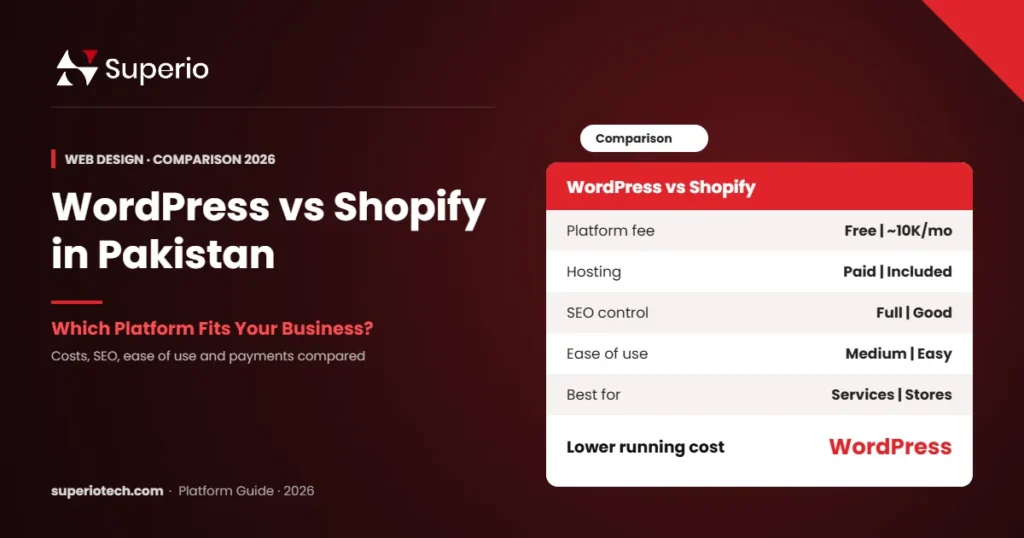
The honest counter-argument: if you sell products, have no technical support, and publish rarely, a hosted store platform is often the better call. We cover that trade-off in detail in our WooCommerce vs Shopify comparison.
What does a WordPress website cost in 2026?
| Build type | Pakistan (PKR) | International (USD) | Best for |
| Template landing page | 15,000 – 35,000 | 300 – 800 | Campaigns, single offers |
| Basic 5-page business site | 35,000 – 80,000 | 800 – 2,000 | New small businesses |
| Custom business site (10–20 pages) | 80,000 – 200,000 | 2,500 – 8,000 | Established SMEs |
| WooCommerce store | 125,000 – 350,000 | 4,000 – 15,000 | Retail and D2C brands |
| Custom / headless build | 300,000 – 1,500,000+ | 15,000 – 60,000+ | Enterprise, high traffic |
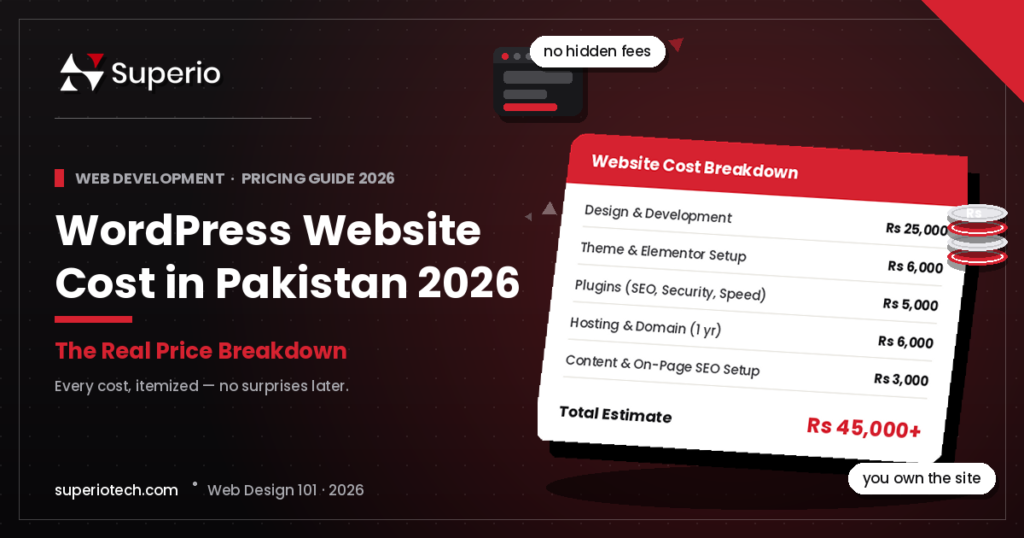
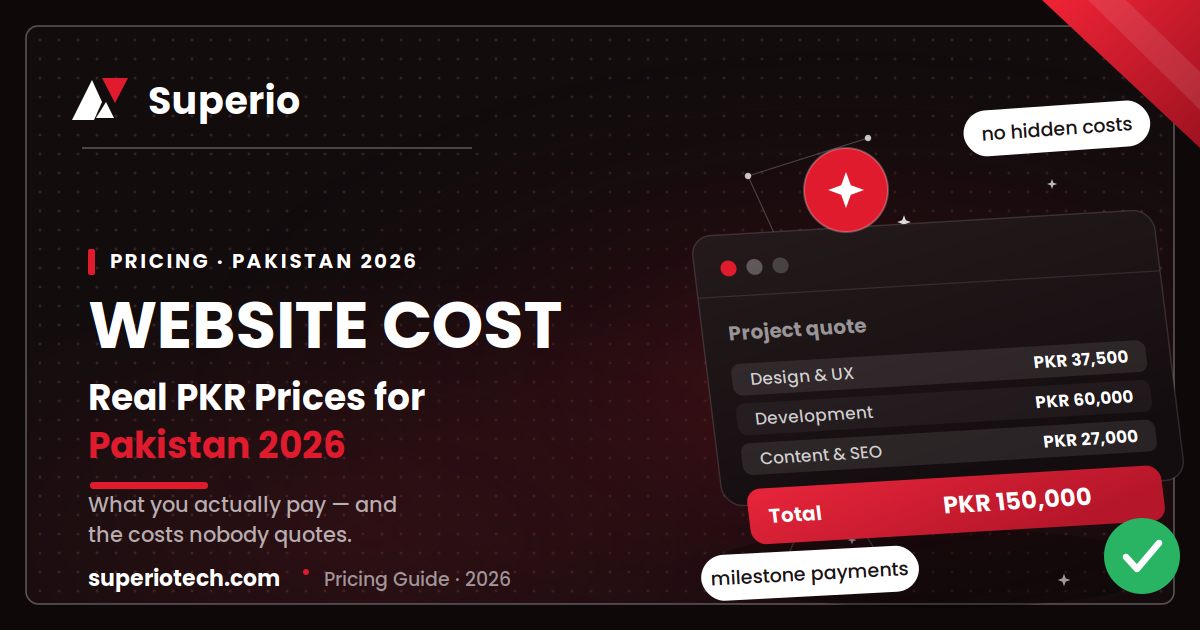
Three things move a quote more than anything else: how much custom design is involved, how many third-party systems have to be integrated, and whether content is supplied or written for you. The full local breakdown, including hosting and domain figures, is in our guide to WordPress website cost in Pakistan.
Ongoing costs to plan for: hosting (PKR 8,000–60,000/year), domain (PKR 3,000–5,000/year), premium plugin licences (PKR 15,000–60,000/year), and maintenance. In general, budget 15–20% of the build cost annually for a website maintenance plan — that covers updates, backups, security monitoring and small fixes.
Need a Website That Brings Leads?
Get a Fast, SEO-Ready Website From SuperioTech
We design and build websites that load fast, look great on mobile and turn visitors into enquiries.
How long does WordPress website development take?
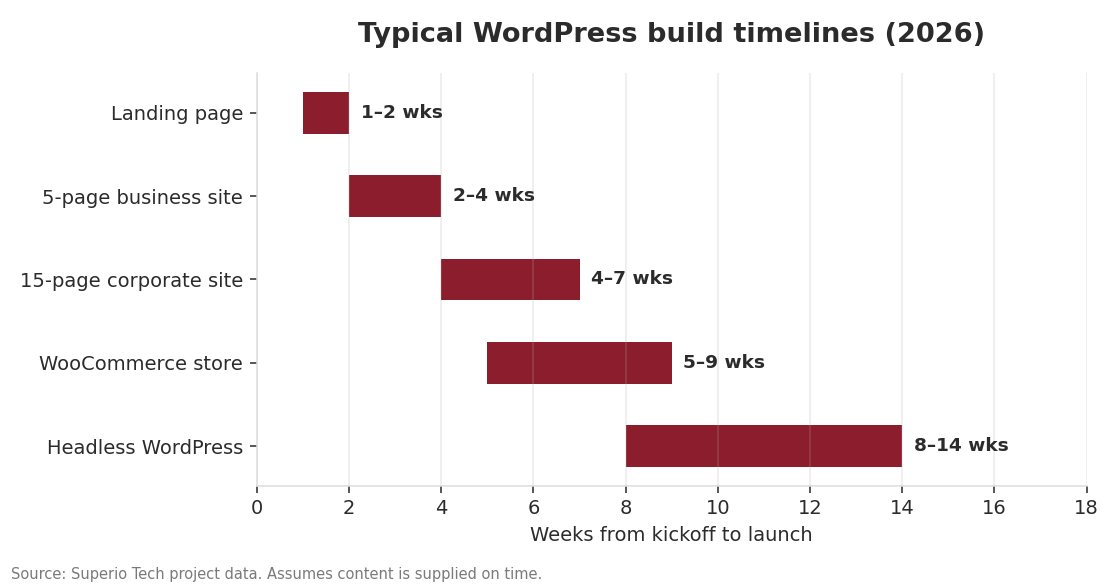
In fact, the single biggest cause of delay is not development. It is content. For example, projects where the client supplies text, product data and photos in week one finish on schedule roughly 80% of the time. In contrast, projects waiting on content routinely run two to four weeks over.
For instance, a realistic phase breakdown for a 15-page corporate site:
- Discovery and sitemap — 3–5 days
- Design (homepage plus key templates) — 7–10 days
- Build and template development — 10–15 days
- Content population — 4–7 days
- SEO, schema, speed and QA — 4–6 days
- Launch and monitoring — 2 days
Headless WordPress or classic WordPress — which do you need?
Headless means WordPress runs the content in the background while the front end is built separately in React, Next.js or a similar framework. It is genuinely the biggest architectural shift in the ecosystem right now, and it is also oversold.
| Question | Classic WordPress | Headless WordPress |
| Marketing team edits pages visually? | Yes, easily | Limited, needs setup |
| Build cost | Baseline | 2–4× baseline |
| Maximum achievable speed | Very good | Excellent |
| Ongoing developer dependency | Low | High |
| Multi-channel content (site + app + kiosk) | Awkward | Ideal |
| Plugin ecosystem available | Full | Partial |
The rule we use: choose headless when you are publishing to more than one destination, have in-house JavaScript developers, and have a measured speed problem that classic optimisation could not solve. Otherwise, a well-built classic WordPress site on good hosting will hit the same business outcome for a fraction of the cost.
How do you build a WordPress site that shows up in AI Overviews and ChatGPT?
This is the part most agencies still skip. AI engines quote pages they can parse cleanly, so the build itself has to cooperate:
- Semantic HTML and a clean heading hierarchy. One H1, logical H2s, no headings used for styling.
- Schema markup on every template. Organization, LocalBusiness, Service, Article and FAQPage at minimum. In addition, Google’s Search documentation lists the supported types.
- Answer-first content blocks. A short, direct answer near the top of each page is what gets lifted into a summary.
- Fast Core Web Vitals. dev is the reference for current thresholds; slow pages get cited less because they get crawled less.
- Consistent entity data. Business name, address and phone identical everywhere — site, Google Business Profile, directories.
- Off-site presence. Most AI citations come from third-party pages, not your own domain, so directory listings, guest posts and review profiles do real work here.
“Ranking number one and being quoted are now two separate jobs. You need the technical foundation for one and the content structure for the other.”
— Superio Tech SEO team
What should you ask before hiring a WordPress development company?
Run any agency through this list before you sign:
- Will I own the hosting account and domain, in my name?
- Do you build with native blocks, a page builder, or a custom theme — and why?
- Which premium plugin licences are included, and who renews them?
- What Core Web Vitals scores will the site launch with?
- Is schema markup included, and which types?
- How many revision rounds are in scope?
- What happens to my site if we stop working together?
- Do you provide staging for testing before changes go live?
- Is content writing included or supplied by me?
- What is the post-launch support window?
- Can I see two live sites you built more than a year ago?
- Is everything in a written contract with milestones?
Any agency that cannot answer 1, 7 and 8 clearly is a risk regardless of price.
Common WordPress website development mistakes
- Plugin sprawl. Thirty plugins doing what eight could. After all, every one is a speed cost and a security surface.
- Nulled themes. In fact, pirated premium themes are the single most common source of the hacked sites we clean up.
- No staging environment. Editing a live site is how businesses end up offline on a Friday afternoon.
- Ignoring mobile. Of course, the majority of Pakistani web traffic is mobile, often on mid-range Android devices. Therefore, design for that device, not your desktop.
- Launching with no analytics. If GA4 and Search Console are not configured at launch, the first three months of data are gone permanently.
- Treating maintenance as optional. Similarly, unpatched core, theme and plugin versions are the leading cause of WordPress compromises.
How Superio Tech builds WordPress sites
We build block-first WordPress sites with speed, schema and analytics configured before launch rather than bolted on afterwards. Every project includes a staging environment, GA4 and Search Console setup, schema markup across templates, and a documented handover so you are never locked to one agency. Our team works from Karachi with clients across Pakistan, the UAE and the US. If you want a scoped quote instead of a price list, our WordPress development services page has the full process.
Ready to start?
Get a WordPress build plan for your business
Tell us what you need and we'll send a scoped quote with timeline, deliverables and a fixed price — no obligation.