
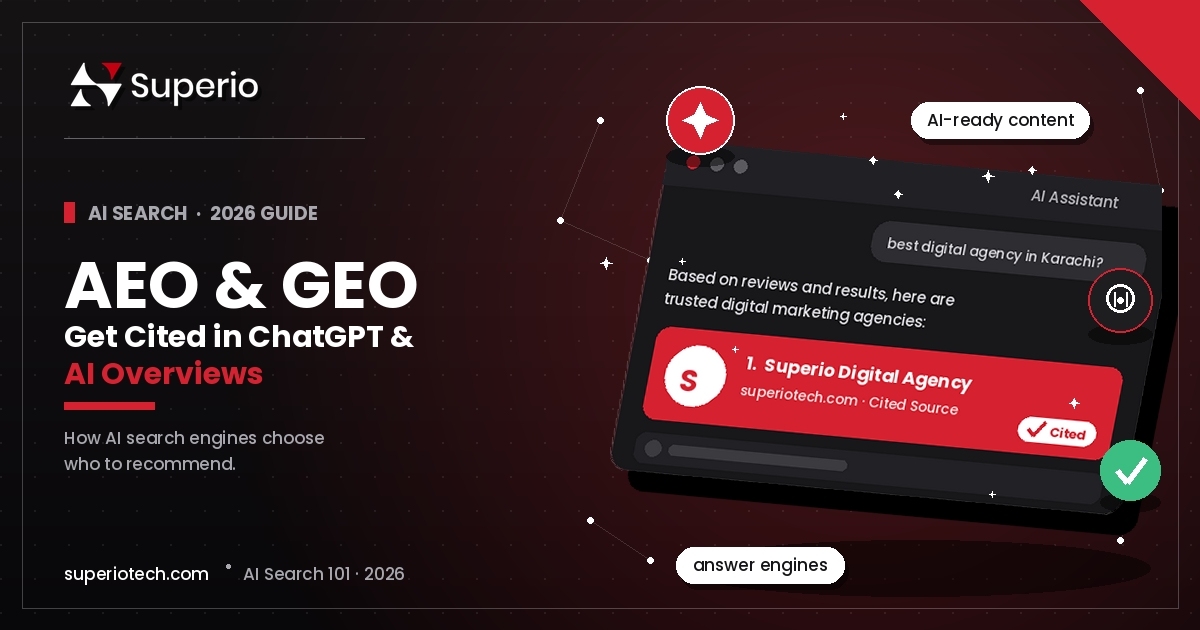
AI search has changed how people find businesses, and most Pakistani companies have not adjusted for it yet.
Your customer used to search Google, scan ten blue links, and click one. Increasingly, they ask ChatGPT, Gemini or Perplexity a question and receive a single synthesised answer — one that names two or three businesses and ignores everyone else. Or they search Google and get an AI Overview at the top that answers the question completely, so the ten blue links never get looked at.
If your business is not one of the sources those answers draw from, you are invisible in that conversation. Not ranked lower. Absent.
This guide explains what answer engine optimisation and generative engine optimisation actually are, what genuinely influences whether AI systems cite you, and what to do about it — in practical terms, for a Pakistani business.
Table of Contents
What AEO and GEO Actually Mean
The terms get used loosely, so here is the practical distinction.
Answer Engine Optimisation (AEO) is optimising so that AI-driven answer systems use your content as a source. The goal is to be quoted and named, not merely to appear in a list.
Generative Engine Optimisation (GEO) is the wider discipline of making your entire web presence legible and credible to generative AI models — your content, your structure, your entity signals, and your reputation across the web.
In practice most people use them interchangeably, and the underlying work overlaps heavily. What matters is understanding the shift they describe.
“Traditional SEO asks: how do I rank for this query? Answer engine optimisation asks a different question: when a machine writes the answer to this query, does it mention me?”
Why AI Search Matters Now
Three things have changed at once.
AI Overviews appear on a large share of searches. Google now generates a summary answer above the organic results for a substantial proportion of queries, including many commercial and brand-related ones. When that summary answers the question fully, the results underneath receive far fewer clicks.
Zero-click behaviour has grown significantly. A majority of Google searches now end without the user clicking through to any website. The answer was on the results page.
People increasingly ask AI tools directly. For research questions, comparisons and recommendations, a growing number of users skip search entirely and ask ChatGPT, Gemini or Perplexity.
The consequence for Pakistani businesses is straightforward. Impressions may hold steady or rise while clicks fall. If you have noticed that pattern in Search Console and could not explain it, this is likely the explanation. Our companion guide on zero-click search covers that symptom in detail.
How AI Search Systems Choose What to Cite
Nobody outside these companies has the full picture, but the observable patterns are reasonably consistent.
AI Search Draws Heavily from Search Results
AI Overviews and most AI search tools retrieve from the existing web index. Content that ranks well is far more likely to be pulled into an AI answer than content that does not. This is the single most important thing to understand.
It means your SEO foundation still matters enormously. If you are not indexed, not ranking, and not credible, no amount of AEO tactics will get you cited. Everything in our guide to on-page and off-page SEO remains as relevant as it was.
They Favour Extractable Content
AI systems need to pull a clear, self-contained statement out of your page. Content structured as a direct answer to a specific question is dramatically easier to extract than the same information buried in the fourth paragraph of a long narrative section.
They Favour Entities Over Keywords
Modern search and AI systems think in entities — real, identifiable things with relationships between them. Your business is an entity. So is your city, your industry, and each of your services. Being clearly and consistently identifiable as a real business with real credentials matters more than repeating a keyword.
They Favour Corroborated Information
If three credible sources say the same thing and you say something different with no support, you are less likely to be used. Consistency across your website, your Google Business Profile, directories and mentions elsewhere builds the corroboration these systems look for.
How to Actually Optimise for AI Search
Here is the practical work, in the order it makes sense to do it.
Answer the Question in the First Two Sentences
Under each heading, state the answer directly before elaborating. Not background, not context — the answer.
Weak: “Many factors influence how much a website costs, and it is important to consider your specific requirements before…”
Strong: “A basic five-page business website in Pakistan costs PKR 25,000 to PKR 60,000 in 2026. The price depends on five things…”
Use Genuine Question Headings
Format headings as the questions your customers actually ask. “How much does SEO cost in Pakistan?” works better than “Pricing Considerations.” This aligns your structure with how queries arrive.
Our guide to keyword research covers how to find the real questions rather than guessing at them.
Add a Key Takeaways Section
A short bulleted summary near the top of every substantial article gives AI systems a clean, self-contained block of facts to draw from. It also helps human readers, which is the better reason to do it.
Implement Structured Data
Schema markup — FAQ, Article, LocalBusiness, Organization — tells machines explicitly what your content is and what your business is. It is not a ranking factor in itself, but it removes ambiguity, and removing ambiguity is most of this job.
Build Entity Consistency
Your business name, address and phone number should be identical everywhere they appear — your website, your Google Business Profile, every directory. Inconsistency creates doubt about whether these listings describe the same business.
For Pakistani businesses this is especially important because address formats vary so widely. Pick one format and use it everywhere. Our guide to local SEO for small businesses in Pakistan covers the local side properly.
Publish Genuinely Useful Original Content
AI systems are trained to identify and prefer content with substance. Original data, first-hand experience, specific figures, and clear expertise all help. Generic content assembled from other generic content does not get cited, because there is no reason to prefer it over the ten identical pages saying the same thing.
This is the part that cannot be shortcut. If you want to be the source, you have to have something worth sourcing.
Get Mentioned Elsewhere
Mentions across credible sites build the corroboration these systems rely on. This is traditional digital PR and link building, and it has become more valuable rather than less. Our post on guest posting covers one route to it.
Free 30-Minute Strategy Session
Is Your Site Visible in AI Search?
We will check whether your business appears in AI Overviews and answer engines for your key terms, and show you exactly what is missing from your content structure.
What Does Not Work in AI Search
Worth saying clearly, because there is a lot of noise in this space.
There is no submission process. You cannot submit your site to ChatGPT or pay to appear in AI Overviews. Anyone selling that is selling nothing.
Keyword stuffing works even less than before. These systems assess meaning, not repetition.
Bulk thin content is counterproductive. Publishing fifty shallow AI-written articles gives these systems fifty reasons to consider your site low-value.
Chasing every new platform is a distraction. The fundamentals — good content, clear structure, technical health, real authority — serve every AI system simultaneously. Optimise for those rather than for one tool’s rumoured preferences.
What to Measure in AI Search
Traditional metrics do not capture this well, so add these.
Impressions versus clicks in Search Console. Rising impressions with flat or falling clicks is the signature of AI answers absorbing your traffic.
Referral traffic from AI tools. Check your analytics for referrals from ChatGPT, Perplexity and similar. The volume is usually modest but the intent is high — these visitors arrive having already read a recommendation.
Manual testing. Ask ChatGPT, Gemini and Perplexity the questions your customers ask. “Best SEO agency in Karachi.” “How much does a website cost in Pakistan.” See whether you appear, and see who does. This is unscientific but genuinely informative.
Branded search volume. If AI systems mention you, some of those people search your name afterwards. Rising branded search is an indirect signal that the strategy is working.
Final Thoughts on AI Search
The uncomfortable truth about AI search is that it rewards the same things good SEO always rewarded — clarity, expertise, structure and credibility — but it punishes vagueness far more harshly than the ten blue links ever did.
A page that half-answers a question could still rank. A page that half-answers a question does not get quoted.
For Pakistani businesses the opportunity here is real, because most of the local market has not adjusted yet. The companies that restructure their content now will be the ones AI systems name for the next several years.
At superiotech, we build AEO structure into every content project we run, because writing for AI extraction and writing clearly for humans turn out to be almost the same job.w
AI-Ready SEO
Want Your Business Named in AI Answers?
Our team restructures your content for answer engines, implements schema, and builds the entity signals that AI systems rely on — on top of the SEO foundations that make it all possible.