
SEO stands for Search Engine Optimization. It is the process of improving a website’s content, structure, technical setup and online reputation so it can appear more prominently when people search for related topics. Its main purpose is to attract relevant visitors through unpaid or organic search results.
Google describes SEO as helping search engines understand your content while helping users find your website and decide whether they should visit it. search results are different from paid advertisements. A business does not pay Google each time someone clicks a normal organic result. However, SEO still requires time, planning, content and technical work.
A Simple SEO Example
Suppose a dental clinic in Islamabad has a website. The clinic wants to reach people searching for:
- Dentist in Islamabad
- Dental clinic near me
- Teeth whitening in Islamabad
- Emergency dentist
- Dental implant cost in Pakistan
An SEO strategy may involve creating clear service pages, improving the clinic’s Google Business Profile, adding accurate contact information and answering common patient questions.
The goal is not to repeat “dentist in Islamabad” in every paragraph. The goal is to create the best page for someone who needs that service.
What SEO Cannot Do
SEO cannot guarantee that a website will always rank first.
Google clearly states:
There are no secrets here that’ll automatically rank your site first in Google
Search rankings depend on many systems, competitors, content quality and user needs. o Search Engines Work?
Search engines generally work through three connected stages: crawling, indexing and serving results. Crawlers discover webpages, indexing systems analyse and store useful information and ranking systems select suitable results when a user searches. A page normally needs to be accessible and indexed before it can gain organic visibility.
Crawling
Google uses automated programs called crawlers to explore the web.
Crawlers discover new and updated pages through:
- Links from other pages
- Internal website links
- XML sitemaps
- Previously discovered URLs
- Manual submissions through Search Console
Google says that most websites in its results are discovered automatically as its crawlers explore the web. xing
After discovering a page, Google tries to understand its content.
It may examine:
- Main text
- Headings
- Images
- Videos
- Internal links
- External links
- Structured data
- Page topic
- Language
- Mobile version
Google may then add the page to its index. The index is a large collection of information gathered from webpages.
Crawling does not guarantee indexing. Google may decide not to index a page if it is blocked, duplicated, low quality or technically inaccessible.
Serving and Ranking Results
When someone performs a search, Google tries to provide useful results from its index.
The order may depend on factors such as:
- Relevance to the search
- Quality and usefulness
- Language
- Location
- Device
- Freshness when needed
- Page experience
- Trust signals
SEO helps a webpage communicate its topic and value more clearly. It does not allow a website owner to control Google’s final decision.
Why Is SEO Important for Businesses in Pakistan?
SEO helps Pakistani businesses reach people who are already searching for their products, services or information. It can support local discovery, qualified website traffic and long-term brand visibility. Unlike paid ads, organic traffic does not stop immediately when an advertising campaign is paused.
Google accounted for approximately 97.14% of Pakistan’s search-engine market across all platforms in July 2026, according to StatCounter. This makes Google visibility highly relevant for businesses targeting users in Pakistan. Reaches People with a Clear Need
Someone searching for “solar company in Pakistan” may be researching an installation.
Someone searching for “AC repair in Karachi” may need urgent help.
These searches show intent. SEO allows a business to appear while a potential customer is actively looking for a solution.
SEO Can Build Long-Term Value
Paid advertising can generate traffic quickly, but the traffic usually ends when the budget stops.
A useful organic page may continue attracting visitors after publication. It still needs monitoring because rankings, competitors and customer needs can change.
SEO Supports Local Businesses
Local SEO can help businesses appear for searches involving:
- A city
- A neighbourhood
- A service area
- “Near me”
- Directions
- Opening hours
- Reviews
This is helpful for clinics, restaurants, repair companies, property agents, schools, lawyers, salons and other location-based businesses.
SEO Improves Website Quality
Many SEO tasks also make the website easier to use.
Clear navigation, readable content, faster loading and mobile-friendly pages can help visitors find information and take action.
What Are the Main Types of SEO?
The four main types are on-page SEO, technical SEO, off-page SEO and local SEO. On-page SEO improves content, technical SEO improves accessibility, off-page SEO builds external trust and local SEO targets customers in specific areas. A complete strategy normally uses more than one type.
On-Page SEO
On-page SEO covers improvements made directly to a webpage.
Common tasks include:
- Matching the page with search intent
- Writing a clear title tag
- Creating a useful meta description
- Using one descriptive H1
- Organising content with H2 and H3 headings
- Adding relevant internal links
- Using keywords naturally
- Optimising images
- Updating outdated information
- Adding a clear call to action
Google recommends using the words people search for in prominent places such as the title, main heading, alt text and link text. nical SEO
Technical SEO helps search engines access, crawl and understand a website.
It may include:
- Fixing indexing problems
- Improving mobile usability
- Using HTTPS
- Creating an XML sitemap
- Fixing broken pages
- Managing redirects
- Improving page speed
- Controlling duplicate URLs
- Checking canonical tags
- Making JavaScript content accessible
- Adding valid structured data
A technically strong website cannot succeed with poor content. However, good content may struggle when search engines cannot access it correctly.
Off-Page SEO
Off-page SEO involves activities and signals outside the website.
These may include:
- Relevant backlinks
- Brand mentions
- Digital public relations
- Business citations
- Industry partnerships
- Customer reviews
- Expert contributions
- Genuine media coverage
A backlink is a link from another website to your page. Relevant links can help people discover content and support its credibility.
Buying hundreds of low-quality backlinks is not a safe shortcut. Links should come from genuine relevance, useful resources and real relationships.
Local SEO
Local SEO helps businesses target customers in a particular city or service area.
Important actions include:
- Creating and verifying a Google Business Profile
- Using the correct business category
- Adding accurate opening hours
- Keeping the phone number and address consistent
- Uploading real business photos
- Requesting genuine customer reviews
- Creating helpful location pages
- Answering local customer questions
A local page should contain useful information about the area. Simply replacing one city name with another across many identical pages adds little value.
Content SEO
Content SEO focuses on planning and publishing information that matches audience needs.
Useful formats include:
- Service pages
- Blog posts
- Buying guides
- Product categories
- Comparisons
- FAQs
- Case studies
- Research
- Videos
- Checklists
Google says there is no preferred word count for ranking. Content should be long enough to answer the question properly without adding unnecessary sections. Is the Difference Between SEO and PPC?
SEO focuses on earning visibility in unpaid search results. PPC involves paying to display advertisements and usually paying when a user clicks. PPC can provide fast visibility, while SEO normally takes longer but can create continuing value. Many businesses use both channels for different goals.
| Factor | SEO | PPC |
| Placement | Organic results | Sponsored results |
| Cost per click | No direct organic click fee | Advertiser normally pays per click |
| Speed | Usually gradual | Can begin quickly |
| Duration | May continue with maintenance | Usually stops when spending stops |
| Control | Rankings are not guaranteed | More control over bids and targeting |
| Best use | Long-term discovery | Fast campaigns and promotions |
Paying for Google Ads does not improve a website’s organic rankings. Google states that advertising has no effect on organic placement. o Do SEO Step by Step
Begin by setting a business goal and researching what your audience searches for. Then check technical access, create the right pages, optimise their content, connect them through internal links and build genuine authority. Finally, measure enquiries, revenue and organic visibility so the strategy can improve over time.
Step 1: Set a Clear Goal
Decide what SEO should achieve.
Possible goals include:
- Generate enquiries
- Increase phone calls
- Sell products
- Attract local customers
- Book appointments
- Build newsletter subscribers
- Grow brand awareness
A high-volume keyword is not useful when it brings visitors who will never become customers.
Step 2: Research Search Intent
Search intent is the reason behind a query.
The main intent types are:
- Informational: The user wants an answer.
- Commercial: The user is comparing options.
- Transactional: The user wants to buy or contact.
- Local: The user wants a nearby business.
- Navigational: The user wants a specific website.
A blog post fits “what is SEO.” A service page fits “hire an SEO agency in Pakistan.”
Step 3: Research Keywords
Find the language customers actually use.
Research:
- Main keywords
- Long-tail phrases
- Customer questions
- Location terms
- Competitor topics
- Search Console queries
- Related services
- Problems customers want to solve
Choose one primary topic for each page. Include related phrases naturally instead of creating a weak page for every keyword variation.
Step 4: Check Technical Access
Confirm that:
- The page loads correctly
- Google is not blocked
- The page is internally linked
- Important content is visible on mobile
- The sitemap contains the page
- The canonical tag is correct
- The page is eligible for indexing
- Images and scripts do not block the main content
Google Search Console’s URL Inspection tool can help identify crawling and indexing problems.
Step 5: Create Useful Content
Answer the main question near the beginning.
Then support the answer with:
- Clear explanations
- Practical steps
- Examples
- Comparisons
- Limitations
- Expert insight
- Visuals
- A suitable next action
Avoid summarising competitors without adding anything new. Google advises against producing large amounts of content that adds little value. 6: Optimise Page Elements
Review:
- SEO title
- Meta description
- URL
- H1
- H2 and H3 headings
- Images
- Alt text
- Internal links
- External references
- Call to action
The title and description should explain the page honestly. Misleading clickbait may earn a click but disappoint the visitor.
Step 7: Build Internal Links
Internal links guide readers and help search engines find related pages.
For example, this article can link to:
- SEO services in Lahore
- PPC services
- Local SEO services
- Website development
- Contact page
Use descriptive anchor text. “Learn about our SEO services in Lahore” is clearer than “click here.”
Step 8: Earn Trust and Mentions
Promote strong content through:
- Business partnerships
- Local directories
- Industry websites
- Social media
- Digital PR
- Expert interviews
- Original data
- Community participation
Focus on genuine visibility. Avoid automated link packages and unrelated directories.
Step 9: Track Results
Use Search Console and analytics tools to monitor:
- Impressions
- Organic clicks
- Landing pages
- Search queries
- Leads
- Calls
- Sales
- Conversion rate
- Indexed pages
The best SEO report connects visibility with business results.
Does SEO Still Matter for AI Search?
Yes. Google states that its established SEO practices remain relevant for AI Overviews and AI Mode. Pages still need useful content, technical accessibility and indexing eligibility. Google does not require a separate AI schema, special content format or secret GEO trick for inclusion in its generative search features.
Google’s current guidance says AI Overviews and AI Mode use its core search ranking and quality systems. They may also use query fan-out, which means performing several related searches to build a fuller response. ns a useful article should cover the main question and related concerns clearly.
For better AI-search visibility:
- Give direct answers
- Use descriptive headings
- Include original insight
- Cite reliable sources
- Add accurate author information
- Keep facts current
- Use clear brand information
- Make pages crawlable
- Include helpful images and videos
- Avoid unsupported claims
Google advises website owners to prioritise valuable, expert-led content rather than “AEO” or “GEO” hacks such as unnecessary AI text files or fake brand mentions. 2026, Google announced dedicated Search Generative AI performance reports in Search Console for a subset of websites. These reports can show impressions, pages, countries, devices and performance dates for visibility in generative search features. oes E-E-A-T Affect SEO?
E-E-A-T means Experience, Expertise, Authoritativeness and Trustworthiness. It helps website owners assess whether their content appears credible and useful. E-E-A-T is not one individual ranking factor, but Google uses different signals that can identify content showing these qualities.
Google explains that:
“Trust is most important” Experience and expertise contribute to that trust. rience
Show real involvement through:
- Original photographs
- Project examples
- Case studies
- Tested processes
- First-hand observations
- Lessons from completed work
Expertise
Explain the topic accurately. Avoid writing confidently about areas the author does not understand.
Authoritativeness
Build recognition through useful resources, relevant mentions, strong topic coverage and credible authors.
Trustworthiness
Support trust with:
- Accurate claims
- Clear authorship
- Secure pages
- Contact details
- Updated information
- Transparent policies
- Reliable sources
- Honest limitations
Add a real author bio to this article. It should explain the writer’s marketing or SEO background without inventing qualifications.
Common SEO Mistakes to Avoid
Common SEO mistakes include keyword stuffing, copied content, poor mobile usability, spam backlinks and unrealistic ranking promises. Businesses also lose opportunities by targeting irrelevant keywords, ignoring local intent and measuring traffic without checking whether that traffic produces enquiries or sales.
Keyword Stuffing
Do not repeat “what is SEO” in every heading and paragraph. Use the primary keyword where it helps clarity.
Publishing Generic Content
A page that repeats common information without examples, evidence or useful advice may struggle to stand out.
Creating Too Many Similar Pages
Avoid making separate pages for every small keyword variation when all phrases share the same intent.
Ignoring Technical Problems
Broken pages, blocked crawling, duplicate URLs and missing internal links can prevent good content from performing properly.
Buying Spam Links
Cheap backlink packages often create links on irrelevant or low-quality websites. These links rarely send qualified visitors.
Publishing Unchecked AI Content
Generative AI can assist research and structure. Google warns that generating many pages without adding value may violate its scaled-content policies. cting Guaranteed Rankings
Google says no one can guarantee a number-one ranking. It advises businesses to avoid agencies making such promises. ong Does SEO Take?
SEO does not have one fixed timeframe. Small technical changes may be processed quickly, while competitive growth can take several months. Results depend on the website’s history, competition, content quality, technical condition, authority and the consistency of the work.
Google says some changes may appear within a few hours, while others may require several months. It generally recommends waiting a few weeks before assessing whether changes had a positive effect. bsite may need more time because it has fewer pages, links, mentions and historical signals.
An established website may improve sooner when the main problems are clear and fixable.
How Much Does SEO Cost in Pakistan?
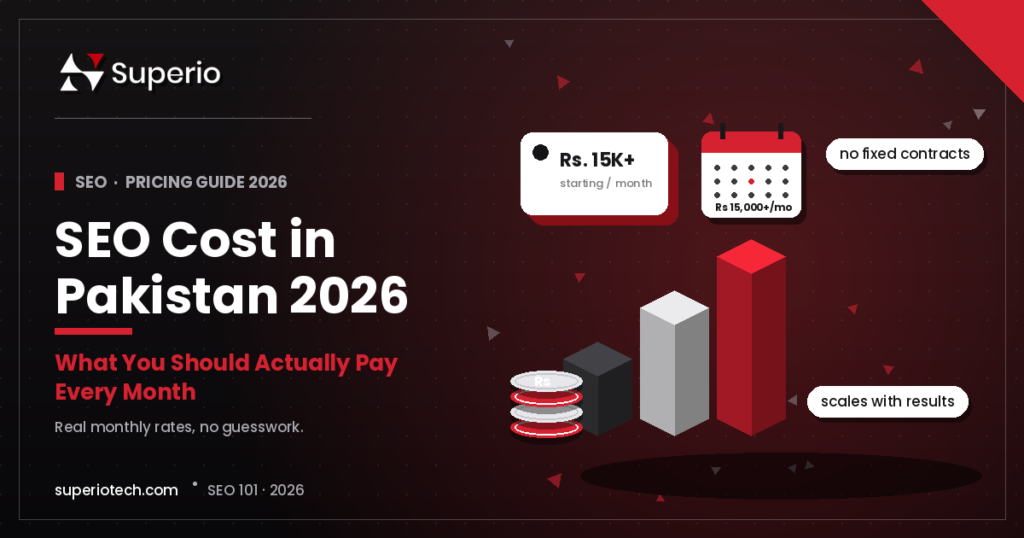
SEO costs vary because websites have different needs. A small local website may require basic technical work and a few service pages. A large ecommerce website may need continuous audits, category optimisation, content, development and link acquisition. Pricing should reflect scope, competition and expected workload.
Important cost factors include:
- Number of pages
- Website condition
- Target locations
- Industry competition
- Content requirements
- Technical development
- Reporting needs
- Link-building approach
- Project duration
Do not choose an agency only because it offers the lowest monthly rate. Ask what work is included and how success will be measured.
How Should You Measure SEO Success?
Measure SEO through business results and search visibility. Important metrics include organic clicks, impressions, qualified enquiries, phone calls, sales and conversion rate. Keyword rankings provide useful context, but they should not be the only measure because rankings can differ by device, location and searcher.
A service business should track:
- Contact forms
- Calls
- WhatsApp enquiries
- Consultation bookings
- Qualified leads
An ecommerce business should track:
- Product sales
- Revenue
- Transactions
- Category traffic
- Assisted conversions
More traffic is not always better. Relevant traffic that produces customers has greater business value.
When Should You Hire an SEO Agency?
Businesses can handle some basic SEO internally, but professional support becomes useful when the website has technical problems, strong competition, many pages or important revenue goals. An experienced agency should explain its work, set realistic expectations and connect recommendations with business needs.
Consider hiring support when:
- Important pages are not indexed
- Organic traffic has dropped
- The website is being redesigned
- Competitors dominate local results
- Content receives traffic but no leads
- The team lacks technical knowledge
- The website has hundreds of pages
- SEO reporting is unclear
Google recommends asking an agency about its previous work, industry experience, market knowledge, communication and measurement process. It also advises businesses to reject guaranteed first-place promises. uperiotech Can Support Your SEO
Superiotech can help Pakistani businesses develop an SEO plan around their website, audience and commercial goals.
A suitable strategy may include:
- Website analysis
- Competitor research
- Keyword planning
- Search-intent mapping
- On-page optimisation
- Technical recommendations
- Content planning
- Internal linking
- Local SEO
- Performance reporting
The right approach depends on the business. A Lahore service company needs a different strategy from a nationwide ecommerce store.
Superiotech should focus on qualified enquiries and sustainable visibility rather than promising instant rankings.
Conclusion
SEO is the process of improving a website so people and search engines can find, understand and trust it.
It combines content, technical work, keywords, links, local information and user experience. It can support visibility in traditional Google results as well as Google’s AI-powered search features.
However, SEO is not an instant solution. Businesses need useful content, clear goals and regular improvement.
Superiotech can help Pakistani businesses identify SEO opportunities and build a strategy connected to measurable results.
Free Strategy Session
Want Your Website to Rank Higher?
Book an SEO consultation with Superiotech to discuss your website, competitors and growth goals