
“E-commerce” sounds simple: you sell things online. However, there are many different ways to do it. A clothing brand selling on Instagram, a marketplace like Daraz and a software company charging monthly fees are all e-commerce businesses, but they work in very different ways. So, this guide on e-commerce examples gives you clear, practical answers.
In this guide, we share practical e-commerce examples and explain the main e-commerce business models. You will see global and Pakistani examples, the pros and cons of each model and which one suits your business best.
Table of Contents
- What Are Some Examples of E-commerce?
- The Main E-commerce Business Models
- 12 E-commerce Examples by Type
- Pros and Cons of These E-commerce Examples
- Advantages of E-commerce for Pakistani Businesses
- Which E-commerce Model Should You Choose?
- E-commerce Examples in Services, Not Just Products
- Omnichannel E-commerce Examples: Online Plus Offline
- Key Features in Successful E-commerce Examples
- Emerging E-commerce Trends to Watch
- How to Learn From E-commerce Examples
- E-commerce Business Model Comparison Summary
- Conclusion
What Are Some Examples of E-commerce?
Common e-commerce examples include online marketplaces like Daraz and Amazon, classified sites like OLX, food delivery apps like Foodpanda, brand websites selling clothes or cosmetics directly, subscription services like Netflix, and B2B platforms like Alibaba that connect manufacturers with wholesale buyers.
In simple words, if money changes hands online for a product or service, it is e-commerce.
The Main E-commerce Business Models
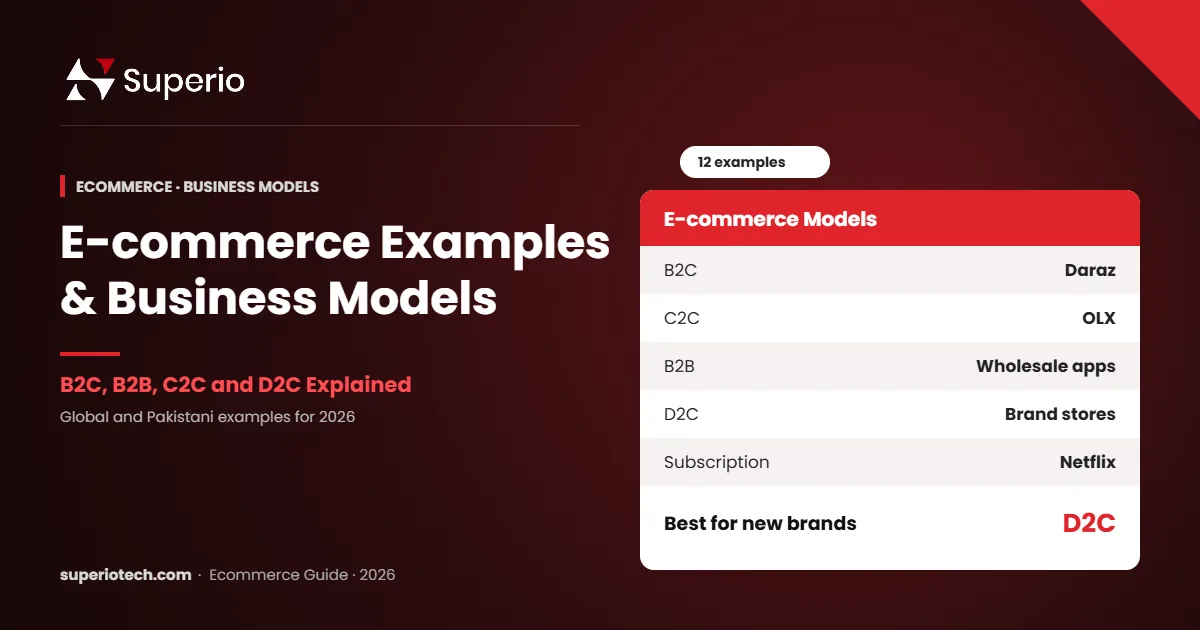
| Model | Who sells to whom | Global example | Pakistani example |
|---|---|---|---|
| B2C | Business to consumer | Amazon | Daraz, PriceOye |
| B2B | Business to business | Alibaba | Wholesale ordering apps |
| C2C | Consumer to consumer | eBay | OLX Pakistan |
| D2C | Brand directly to consumer | Brand-owned stores | Local fashion and skincare brands |
| C2B | Consumer to business | Freelance platforms | Pakistani freelancers on Upwork or Fiverr |
B2C (Business to Consumer)
This is the most common model. A business sells products directly to individual buyers. For example, an electronics store selling mobile phones online is B2C.
B2B (Business to Business)
Here, one business sells to another. For example, a manufacturer sells stock to retailers through an online ordering platform. B2B orders are usually bigger but less frequent.
C2C (Consumer to Consumer)
In this model, individuals sell to other individuals through a platform. OLX Pakistan is a well-known example, where people sell used phones, cars and furniture.
D2C (Direct to Consumer)
D2C brands make their own products and sell them directly through their own website and social media, without middlemen. Many Pakistani clothing and skincare brands follow this model. As a result, they keep higher margins and own their customer data.
12 E-commerce Examples by Type
1. Online Marketplaces
Platforms like Daraz and Amazon host thousands of sellers. Buyers enjoy choice, while sellers get access to ready traffic.
2. Single-Brand Online Stores
A clothing brand selling only its own collections on a Shopify or WordPress website is a classic example.
3. Electronics Retailers
Online electronics stores such as PriceOye sell phones, gadgets and appliances with delivery across Pakistan.
4. Food Delivery Platforms
Foodpanda connects restaurants with customers. It is e-commerce for services and prepared food.
5. Online Grocery
Grocery apps deliver daily essentials, often within hours in big cities.
6. Classifieds
OLX lets people list items for sale and contact buyers directly.
7. Travel Booking
Sites like Sastaticket sell flight and bus tickets online.
8. Subscription Services
Netflix, Spotify and software tools charge monthly fees. Local examples include subscription meal or coffee services.
9. Digital Products
E-books, online courses, templates and software are sold and delivered instantly online.
10. Dropshipping Stores
The store owner sells products without holding stock. A supplier ships directly to the customer.
11. Social Commerce
Many small businesses sell through Instagram, Facebook and WhatsApp, taking orders in messages.
12. Export E-commerce
Pakistani sellers export handicrafts, leather goods and textiles to international buyers through their own sites or global marketplaces such as Amazon and Etsy.
Not Sure Which Model Fits You?
Plan Your Ecommerce Business With SuperioTech
We help you choose the right model, platform and marketing plan for your products.
Pros and Cons of These E-commerce Examples
| Model | Pros | Cons |
|---|---|---|
| Marketplace seller | Ready buyers, quick start | Commission, price competition |
| D2C brand store | High margins, own customer data | You must bring your own traffic |
| Dropshipping | Low stock risk | Thin margins, slow delivery, quality control issues |
| Subscription | Predictable monthly income | Must keep customers happy to avoid cancellations |
| Social commerce | Free to start, personal contact | Hard to scale and manage orders |
Advantages of E-commerce for Pakistani Businesses
- Reach the whole country: sell beyond your city.
- Open 24/7: customers can order any time.
- Lower costs: no expensive shop rent in prime locations.
- Better data: track what customers buy and when.
- Export potential: sell to overseas Pakistanis and global buyers.
Pakistan has well over 140 million broadband subscribers, giving online sellers a huge potential audience. — based on PTA telecom indicators
Which E-commerce Model Should You Choose?
- You make your own products? Build a D2C brand store.
- You resell many products? Start on a marketplace, then add your own store.
- You sell to shops and businesses? Set up a B2B ordering website.
- You offer a regular service? Consider a subscription model.
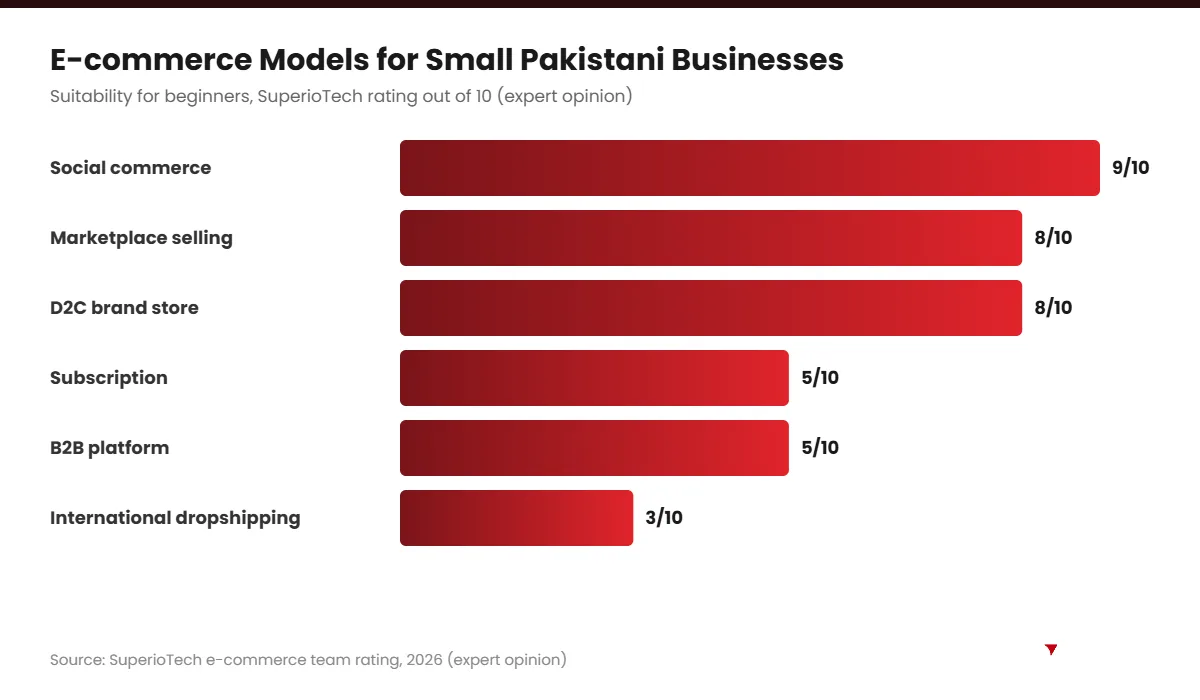
- You are just testing? Start with social commerce, then move to a website.
In our experience at SuperioTech, the strongest Pakistani brands combine models. For example, they sell on Daraz for reach, on Instagram for engagement and on their own website for higher margins.
Ready to start? Read our guide on how to start an ecommerce business in Pakistan and compare platforms in WordPress vs Shopify. For a full-service approach, explore our e-commerce agency services. You can also learn more about business models from Shopify’s guide to e-commerce business models.
E-commerce Examples in Services, Not Just Products
Many people think e-commerce means only physical products. However, services are sold online every day too. Here are practical e-commerce examples from the service world:
- Online doctor consultations: patients book and pay for video appointments.
- Tutoring platforms: students pay for online classes and courses.
- Event tickets: concerts, cinemas and conferences sell tickets online.
- Home services: customers book cleaners, plumbers or AC technicians through apps.
- Freelance services: designers and developers sell services on global platforms.
- Software subscriptions: businesses pay monthly for tools like accounting or CRM software.
So, if you run a service business, e-commerce can still help you take bookings and payments online.
Omnichannel E-commerce Examples: Online Plus Offline
Some of the strongest e-commerce examples combine online and physical stores. This is called omnichannel retail. For instance, a clothing brand may let customers order online and exchange items at a local outlet.
| Omnichannel feature | Customer benefit |
|---|---|
| Buy online, pick up in store | No delivery wait or charge |
| Exchange online orders in store | Easy size changes |
| Check stock online | Saves a wasted trip |
| Same loyalty points everywhere | Rewards for every purchase |
For businesses with physical shops in Pakistan, adding a website can increase sales without losing in-store customers.
Key Features in Successful E-commerce Examples
When we study successful e-commerce examples, the same features appear again and again:
- Fast loading pages: especially on mobile data.
- Clear navigation: easy categories and search.
- Great product photos: multiple angles and zoom.
- Detailed descriptions: sizes, materials and delivery times.
- Trust signals: reviews, return policy and contact details.
- Simple checkout: few steps, COD and online payment.
- Order tracking: updates by SMS, email or WhatsApp.
Whether you run a small store or a large marketplace, these basics matter most.
Emerging E-commerce Trends to Watch
E-commerce keeps changing. Here are trends that are shaping online selling in Pakistan and worldwide:
- Social commerce growth: more buying directly through Instagram, TikTok and WhatsApp.
- Digital payments: wider use of Raast, mobile wallets and QR payments.
- Live selling: brands sell products during live videos.
- AI-powered shopping: smarter product recommendations and chatbots.
- Faster delivery: same-day delivery in major cities.
- Cross-border selling: Pakistani brands selling to overseas Pakistanis.
Keeping an eye on these trends helps you choose the right e-commerce model for the future.
How to Learn From E-commerce Examples
Studying other businesses is useful, but only if you act on it. Here is a simple process:
- Pick three e-commerce examples in your niche.
- Note their pricing, delivery promises and return policies.
- Study their product pages and checkout process.
- Follow their social media to see how they market.
- List three things you can do better.
Then, apply those improvements to your own store. Over time, these small upgrades add up. For a full launch plan, read our guide on how to start an ecommerce business in Pakistan, and see Shopify stores in Pakistan for more local ideas.
E-commerce Business Model Comparison Summary
| Model | Start-up cost | Margin | Control |
|---|---|---|---|
| Social commerce | Very low | Medium | Low |
| Marketplace | Low | Low–medium | Low |
| D2C store | Medium | High | High |
| B2B platform | Medium–high | Medium | High |
| Subscription | Medium | High over time | High |
Use this summary to match a model with your budget and goals.
Conclusion
E-commerce examples range from giant marketplaces to small brands selling on Instagram. The key models are B2C, B2B, C2C and D2C, and each has its own strengths. Most small Pakistani businesses do best starting with B2C or D2C, then expanding to other channels.
Choose the model that fits your products and goals. If you want help building the right setup, SuperioTech is here to guide you.
Ready to Build Your Online Store?
Book a Free Ecommerce Strategy Session
Tell us about your business, and we will suggest the best e-commerce model and setup.